
Search
found 4556 results
Images for christchurch earthquake; more images...


New Zealand Defence Force photograph 230
Images, UC QuakeStudies
Photograph captioned by the New Zealand Defence Force, "Chief of Defence Force, Major General Rhys Jones on an operational tour of earthquake affected areas of Christchurch".
Photograph by Jennifer Middendorf 391
Images, UC QuakeStudies
A sign on the side of one of the containers in Re:Start mall reads, "Re:Start, proudly supported by Christchurch Earthquake Appeal. Tomorrow starts here".
New Zealand Defence Force photograph 227
Images, UC QuakeStudies
Photograph captioned by the New Zealand Defence Force, "Chief of Defence Force, Major General Rhys Jones on an operational tour of earthquake affected areas of Christchurch".
Ray Whelan WEMO Photograph 04
Images, UC QuakeStudies
A photograph of an earthquake damaged building in the Christchurch central city. Some of the windows have broken and have been covered with plastic and tape.
Nic Johns and Mark Osborne WEMO Photograph 121
Images, UC QuakeStudies
A photograph of volunteers from the Wellington Emergency Management Office standing on a pile of bricks from an earthquake-damaged building in the Christchurch central city.
New Zealand Defence Force photograph 588
Images, UC QuakeStudies
Aerial image of the Christchurch central city taken by the Royal New Zealand Air Force for the Earthquake Commission. The Hotel Grand Chancellor can be seen.
New Zealand Defence Force photograph 125
Images, UC QuakeStudies
Medics from the New Zealand Army checking on rest home residents on an aircraft. The residents were evacuated from Christchurch after the 22 February 2011 earthquake.
Homage to the Lost Spaces Photograph 6
Images, UC QuakeStudies
A photograph of part of Mike Hewson's installation 'Homage to the Lost Spaces' on the earthquake-damaged Cranmer Courts building.
The Star 7 September 2012.
Articles, UC QuakeStudies
A PDF copy of The Star newspaper, published on Friday 7 September 2012.
The Star 9 March 2012
Articles, UC QuakeStudies
A PDF copy of The Star newspaper, published on Friday 9 March 2012.
Lessons Learned for Steel Seismic Design from the 2010/2011 Canterbury Ear…
Research papers, The University of Auckland Library
The Canterbury earthquake series of 2010/2011 has turned the city of Christchurch into a full scale natural laboratory testing the structural and non-structural response of buildings under moderate to very severe earthquake shaking. The lessons learned from this, which have come at great cost socially and economically, are extremely valuable in increasing our understanding of whole building performance in severe earthquakes. Given current initiatives underway on both sides of the Tasman towards developing joint Australasian steel and composite steel/concrete design and construction standards that would span a very wide range of geological conditions and seismic zones, these lessons are relevant to both countries. This paper focusses on the performance of steel framed buildings in Christchurch city, with greatest emphasis on multi-storey buildings, but also covering single storey steel framed buildings and light steel framed housing. It addresses such issues as the magnitude and structural impact of the earthquake series, importance of good detailing, lack of observed column base hinging, the excellent performance of composite floors and it will briefly cover research underway to quantify some of these effects for use in design.
Crack'd for Christchurch Photograph 129
Images, UC QuakeStudies
A photograph of Marie Hudson working on Crack'd for Christchurch's armchair artwork.Crack'd for Christchurch comments, "Slow progress. Sometimes we thought we'd never get her finished. We were all battling our own earthquake consequences: losing homes and jobs, battling with insurers, illnesses and repairs. It was a long winter. But the conversation, food, laughter, and company were wonderful. An unforgettable experience."
Crack'd for Christchurch Photograph 126
Images, UC QuakeStudies
A photograph of Helen Campbell working on Crack'd for Christchurch's armchair artwork.Crack'd for Christchurch comments, "Slow progress. Sometimes we thought we'd never get her finished. We were all battling our own earthquake consequences: losing homes and jobs, battling with insurers, illnesses and repairs. It was a long winter. But the conversation, food, laughter, and company were wonderful. An unforgettable experience."
Crack'd for Christchurch Photograph 127
Images, UC QuakeStudies
A photograph of Helen Campbell and Marie Hudson working on Crack'd for Christchurch's armchair artwork.Crack'd for Christchurch comments, "Slow progress. Sometimes we thought we'd never get her finished. We were all battling our own earthquake consequences: losing homes and jobs, battling with insurers, illnesses and repairs. It was a long winter. But the conversation, food, laughter, and company were wonderful. An unforgettable experience."
Crack'd for Christchurch Photograph 131
Images, UC QuakeStudies
A photograph of Crack'd for Christchurch's partially-completed mosaic on their armchair.Crack'd for Christchurch comments, "Slow progress. Sometimes we thought we'd never get her finished. We were all battling our own earthquake consequences: losing homes and jobs, battling with insurers, illnesses and repairs. It was a long winter. But the conversation, food, laughter, and company were wonderful. An unforgettable experience."
Crack'd for Christchurch Photograph 128
Images, UC QuakeStudies
A photograph of Helen Campbell working on Crack'd for Christchurch's armchair artwork.Crack'd for Christchurch comments, "Slow progress. Sometimes we thought we'd never get her finished. We were all battling our own earthquake consequences: losing homes and jobs, battling with insurers, illnesses and repairs. It was a long winter. But the conversation, food, laughter, and company were wonderful. An unforgettable experience."
Crack'd for Christchurch Photograph 130
Images, UC QuakeStudies
A photograph of Crack'd for Christchurch's partially-completed mosaic on their armchair.Crack'd for Christchurch comments, "Slow progress. Sometimes we thought we'd never get her finished. We were all battling our own earthquake consequences: losing homes and jobs, battling with insurers, illnesses and repairs. It was a long winter. But the conversation, food, laughter, and company were wonderful. An unforgettable experience."
Crowd on The Grassy
Images, eqnz.chch.2010
Photos taken at the Lyttelton Community briefing held on March 7 2011 following the magnitude 6.3 earthquake on 22 February 2011. File Ref: CCL-2011-03-07-Lyttelton-Community-Briefing-P1110625 From the collection of Christchurch City Libraries.
TV3 reporter Ali Ikram
Images, eqnz.chch.2010
Photos taken at the Lyttelton Community briefing held on March 7 2011 following the magnitude 6.3 earthquake on 22 February 2011. File Ref: CCL-2011-03-07-Lyttelton-Community-Briefing-P1110622 From the collection of Christchurch City Libraries.
Large crowd at community briefing
Images, eqnz.chch.2010
Photos taken at the Lyttelton Community briefing held on March 7 2011 following the magnitude 6.3 earthquake on 22 February 2011. File Ref: CCL-2011-03-07-Lyttelton-Community-Briefing-P1110619 From the collection of Christchurch City Libraries.
Photographer in the crowd
Images, eqnz.chch.2010
Photos taken at the Lyttelton Community briefing held on March 7 2011 following the magnitude 6.3 earthquake on 22 February 2011. File Ref: CCL-2011-03-07-Lyttelton-Community-Briefing-P1110621 From the collection of Christchurch City Libraries.
New Zealand Defence Force photograph 675
Images, UC QuakeStudies
The US Aid tent in Latimer Square. After the 22 February 2011 earthquake, emergency service agencies set up their headquarters in Latimer Square.
Poster for Dancing Through Impermanent Spaces
Images, UC QuakeStudies
A copy of the poster used to advertise screenings of Elizabeth Guthrey's film series 'Dancing Through Impermanent Spaces'. The films are a creative response to the earthquakes in Christchurch and were shown as part of the Christchurch Body Festival 2014.
Play, politics and the production of space: DIY urbanism in post-earthquak…
Research papers, The University of Auckland Library
The Canterbury earthquake sequence of 2010-2011 wrought ruptures in not only the physical landscape of Canterbury and Christchurch’s material form, but also in its social, economic, and political fabrics and the lives of Christchurch inhabitants. In the years that followed, the widespread demolition of the CBD that followed the earthquakes produced a bleak landscape of grey rubble punctuated by damaged, abandoned buildings. It was into this post-earthquake landscape that Gap Filler and other ‘transitional’ organisations inserted playful, creative, experimental projects to bring life and energy back into the CBD. This thesis examines those interventions and the development of the ‘Transitional Movement’ between July 2013 and June 2015 via the methods of walking interviews and participant observation. This critical period in Christchurch’s recovery serves as an example of what happens when do-it-yourself (DIY) urbanism is done at scale across the CBD and what urban experimentation can offer city-making. Through an understanding of space as produced, informed by Lefebvre’s thinking, I explore how these creative urban interventions manifested a different temporality to orthodox planning and demonstrate how the ‘soft’ politics of these interventions contain the potential for gentrification and also a more radical politics of the city, by creating an opening space for difference.
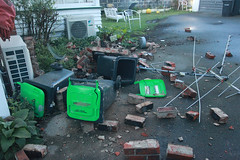
boxes down
Images, eqnz.chch.2010
None
PGC building
Images, eqnz.chch.2010
The CTV collapse is the worst and most devastating, from what I saw of the CBD yesterday.
brick fence down
Images, eqnz.chch.2010
None
Photograph by Neil Macbeth 119
Images, UC QuakeStudies
An attendee of the 2011 United States New Zealand Partnership Forum outside the Christchurch Art Gallery. In the background, members of Civil Defence have gathered after an aftershock hit during one of their briefings. The Christchurch Art Gallery served as the headquarters for Civil Defence after the 22 February 2011 earthquake.
Photograph by Neil Macbeth 118
Images, UC QuakeStudies
Attendees of the 2011 United States New Zealand Partnership Forum outside the Christchurch Art Gallery. In the background, members of Civil Defence have gathered after an aftershock hit during one of their briefings. The Christchurch Art Gallery served as the headquarters for Civil Defence after the 22 February 2011 earthquake.
New Zealand Defence Force photograph 746
Images, UC QuakeStudies
PTE Sony Watson, from the 3rd Catering and Supply Company, cleaning a helmet in the decontamination area. The area was set up after the 22 February 2011 earthquake in order to decontaminate equipment used in Operation Christchurch Quake.