
Search
found 4556 results
Images for Earthquake Christchurch; more images...


sand volcano
Images, eqnz.chch.2010
Laura, Nicola, and Debra watch a sand volcano build in the Wyn Street gutter.
Cockatiel down!
Images, eqnz.chch.2010
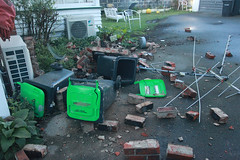
Bruce and his cage were sitting on top of the small wooden table on the right before the earthquake. He was understandably alarmed.
All Right? Social Media: Facebook Timeline Image 92
Images, UC QuakeStudies
A photograph of Christchurch Mayor Lianne Dalziel at a River of Flowers earthquake memorial event in the Botanic Gardens. She is standing near the Tree of Hope and holding a hand-written message. The message is written on one of the All Right? Earthquake Anniversary postcards. All Right? posted the photograph on their Facebook page on 22 February 2014 at 1:36pm.
Workers
Images, eqnz.chch.2010
Photos taken in Lyttelton showing the demolition of various buildings following the February 22 earthquake. File reference: CCL-2011-05-20-Lyttelton-Demolition-P1120462 From the collection of Christchurch City Libraries.
Worker
Images, eqnz.chch.2010
Photos taken in Lyttelton showing the demolition of various buildings following the February 22 earthquake. File reference: CCL-2011-04-29-Lyttelton-Demolition-P1120222 From the collection of Christchurch City Libraries.
Satchmo
Images, eqnz.chch.2010
Photos taken in Lyttelton showing the demolition of various buildings following the February 22 earthquake. File reference: CCL-2011-05-20-Lyttelton-Demolition-P1120453 From the collection of Christchurch City Libraries.
Closeup of the booth
Images, eqnz.chch.2010
File reference: CCL-2011-11-22-IMG_0783PODattheShow November2011 From the collection of Christchurch City Libraries.
Community in Mind: Hei Puawai Waitaha - a flourishing Waitaha
Articles, UC QuakeStudies
A PDF copy of a publication about rebuilding health and wellbeing in greater Christchurch. The publication was produced by CERA in June 2014.
Experimental Modal Identification of Structures under Earthquake Excitation
Research papers, The University of Auckland Library
Micro - electro - mechanical system (MEMS) based accelerometers are now frequently used in many different parts of our day - to - day lives. It is also increasingly being used for structural testing applications. Researchers have had res ervation of using these devices as they are relatively untested, but now with the wider adoption, it provides a much cheaper and more versatile tool for structural engineering researchers. A number of damaged buildings in the Christchurch Central Business District (CBD) were instrumented with a number of low - cost MEMS accelerometers after the major Christchurch earthquakes. The accelerometers captured extremely high quality building response data as the buildings experienced thousands of aftershocks. This d ata set was amongst one of only a handful of data set s available around the world which provides building response data subjected to real ground motion. Furthermore, due to technological advances, a much larger than usual number of accelerometers has been deployed making the data set one of the most comprehensive available. This data set is utilised to extract modal parameters of the buildings. This paper summarises the operating requirements and preference for using such accelerometers for experimental mod al analysis. The challenges for adapting MEMS based devices for successful modal parameters identification are also discussed.
Jennifer Middendorf's Blog 30/08/2014: A photographic tour of Christchurch
Articles, UC QuakeStudies
An entry from Jennifer Middendorf's blog for 30 August 2014 entitled, "A photographic tour of Christchurch".
Story time at the welfare centre
Images, eqnz.chch.2010
Photos of Christchurch City LIbraries Outreach staff working in welfare centres following the February 22 earthquake. File ref: CCL-2011-02-27-OperationStoryTime-lynette-and-boys-on-bikes From the collection of Christchurch City Libraries
WEMO ERT Set 1 - February 2011 - Photograph 65
Images, UC QuakeStudies
A photograph of emergency management personnel exiting the car park of the earthquake-damaged Press House on Gloucester Street.
Nic Johns and Mark Osborne WEMO Photograph 064
Images, UC QuakeStudies
A photograph of volunteers from the Wellington Emergency Management Office at the Christchurch Art Gallery. The Art Gallery was set up as the temporary headquarters for Civil Defence after the 4 September 2010 earthquake.
People in Disasters Conference - Understanding Immediate Human Behaviour t…
Videos, UC QuakeStudies
A video of a presentation by Professor David Johnston during the fourth plenary of the 2016 People in Disasters Conference. Johnston is a Senior Scientist at GNS Science and Director of the Joint Centre for Disaster Research in the School of Psychology at Massey University. The presentation is titled, "Understanding Immediate Human Behaviour to the 2010-2011 Canterbury Earthquake Sequence, Implications for injury prevention and risk communication".The abstract for the presentation reads as follows: The 2010 and 2011 Canterbury earthquake sequences have given us a unique opportunity to better understand human behaviour during and immediately after an earthquake. On 4 September 2010, a magnitude 7.1 earthquake occurred near Darfield in the Canterbury region of New Zealand. There were no deaths, but several thousand people sustained injuries and sought medical assistance. Less than 6 months later, a magnitude 6.2 earthquake occurred under Christchurch City at 12:51 p.m. on 22 February 2011. A total of 182 people were killed in the first 24 hours and over 7,000 people injured overall. To reduce earthquake casualties in future events, it is important to understand how people behaved during and immediately after the shaking, and how their behaviour exposed them to risk of death or injury. Most previous studies have relied on an analysis of medical records and/or reflective interviews and questionnaire studies. In Canterbury we were able to combine a range of methods to explore earthquake shaking behaviours and the causes of injuries. In New Zealand, the Accident Compensation Corporation (a national health payment scheme run by the government) allowed researchers to access injury data from over 9,500 people from the Darfield (4 September 2010) and Christchurch (22 February 2011 ) earthquakes. The total injury burden was analysed for demography, context of injury, causes of injury, and injury type. From the injury data inferences into human behaviour were derived. We were able to classify the injury context as direct (immediate shaking of the primary earthquake or aftershocks causing unavoidable injuries), and secondary (cause of injury after shaking ceased). A second study examined people's immediate responses to earthquakes in Christchurch New Zealand and compared responses to the 2011 earthquake in Hitachi, Japan. A further study has developed a systematic process and coding scheme to analyse earthquake video footage of human behaviour during strong earthquake shaking. From these studies a number of recommendations for injury prevention and risk communication can be made. In general, improved building codes, strengthening buildings, and securing fittings will reduce future earthquake deaths and injuries. However, the high rate of injuries incurred from undertaking an inappropriate action (e.g. moving around) during or immediately after an earthquake suggests that further education is needed to promote appropriate actions during and after earthquakes. In New Zealand - as in US and worldwide - public education efforts such as the 'Shakeout' exercise are trying to address the behavioural aspects of injury prevention.
Exemplar seismic retrofits of Christchurch URM buildings
Research papers, The University of Auckland Library
Case study unreinforced masonry (URM) buildings that were seismically retrofitted prior to the 2010/11 Canterbury earthquake sequence and exhibited successful performance during these earthquakes are presented herein. Selected buildings were divided into the following categories based on size and complexity: (1) simple, single storey box type buildings (i.e. electrical substations), (2) common and simple commercial buildings, and (3) large and complex clay brick and stone URM buildings. The retrofitted case study URM buildings were evaluated based on overall structural seismic performance as well as the categories of initial seismic design, heritage preservation, architectural appeal, and cost. Detailed observations of 4 representative case study buildings and a summary of findings are reported herein. http://db.nzsee.org.nz/2017/Orals.htm
Cyclic Undrained DSS Testing of Christchurch Sandy Silty Soils
Research papers, University of Canterbury Library
Earthquake-triggered soil liquefaction caused extensive damage and heavy economic losses in Christchurch during the 2010-2011 Canterbury earthquakes. The most severe manifestations of liquefaction were associated with the presence of natural deposits of clean sands and silty sands of fluvial origin. However, liquefaction resistance of fines-containing sands is commonly inferred from empirical relationships based on clean sands (i.e. sands with less than 5% fines). Hence, existing evaluation methods have poor accuracy when applied to silty sands. The liquefaction behaviour of Christchurch fines-containing (silty) sands is investigated through a series of Direct Simple Shear (DSS) tests. This type of test better resembles earthquake loading conditions in soil deposits compared to cyclic triaxial tests. Soil specimens are reconstituted in the laboratory with the water sedimentation technique. This preparation method yields soil fabrics similar to those encountered in fluvial soil deposits, which are common in the Christchurch area. Test results provide preliminary indications on how void ratio, relative density, preparation method and fines content influence the cyclic liquefaction behaviour of sand-silt mixtures depending on the properties of host sand and silt.
Homage to the Lost Spaces Photograph 7
Images, UC QuakeStudies
A photograph of Mike Hewson's installation 'Homage to the Lost Spaces' on the earthquake-damaged Cranmer Courts building.
Homage to the Lost Spaces Photograph 8
Images, UC QuakeStudies
A photograph of Mike Hewson's installation 'Homage to the Lost Spaces' on the earthquake-damaged Cranmer Courts building.
Paul on duty at the show
Images, eqnz.chch.2010
File reference: CCL-2011-11-22-378725_10150525003098054_95658493053_10354724_499732666_n PODattheShow November2011 From the collection of Christchurch City Libraries.
EXAMPLES OF RECOGNITION OF VULNERABILITY IN NATURAL DISASTER CONTEXTS (ESP…
Research papers, University of Canterbury Library
These research papers explore the concept of vulnerability in international human rights law. In the wake of the Christchurch earthquakes of 2010-2011, this research focuses on how "vulnerability" has been used and developed within the wider human rights discourse. They also examine jurisprudence of international human rights bodies, and how the concept of "vulnerability" has been applied. The research also includes a brief investigation into the experiences of vulnerable populations in disaster contexts, focusing primarily on the experiences of "vulnerable persons" in the Christchurch earthquakes and their aftermath.
Wellington Cordon Project
Research papers, University of Canterbury Library
INTRODUCTION This project falls under the Flagship 3: Wellington Coordinated Project. It supports other projects within FP3 to create a holistic understanding of risks posed by collapsed buildings due to future earthquake/s and the secondary consequences of cordoning in the short, mid and long term. Cordoning of the Christchurch CBD for more than two years and its subsequent implications on people and businesses had a significant impact on the recovery of Christchurch. Learning from this and experiences from the Kaikōura earthquake (where cordons were also established around selected buildings, Figure 3) have highlighted the need to understand the effects of cordons and plan for it before an earthquake occurs
WEMO ERT Set 1 - February 2011 - Photograph 52
Images, UC QuakeStudies
A photograph of a member of the Wellington Emergency Management Office Emergency Response Team taking photograph through a car window. In the distance is the earthquake-damaged tower of the ChristChurch Cathedral.
The Star 12 October 2011
Articles, UC QuakeStudies
A PDF copy of The Star newspaper, published on Wednesday 12 October 2011.
The Star 14 October 2011
Articles, UC QuakeStudies
A PDF copy of The Star newspaper, published on Friday 14 October 2011.
The Star 4 July 2012
Articles, UC QuakeStudies
A PDF copy of The Star newspaper, published on Wednesday 4 July 2012.
The Star 27 March 2013
Articles, UC QuakeStudies
A PDF copy of The Star newspaper, published on Wednesday 27 March 2013.
The Star 21 September 2012.
Articles, UC QuakeStudies
A PDF copy of The Star newspaper, published on Friday 21 September 2012.
New Zealand Defence Force photograph 039
Images, UC QuakeStudies
A member of the Royal New Zealand Air Force examining documentation outside the C-130 Hercules at Christchurch airport. The Hercules was being used to evacuate people from Christchurch after the 22 February 2011 earthquake.
New Zealand Defence Force photograph 040
Images, UC QuakeStudies
A member of the Royal New Zealand Air Force examining documentation outside the C-130 Hercules at Christchurch airport. The Hercules was being used to evacuate people from Christchurch after the 22 February 2011 earthquake.
New Zealand Defence Force photograph 037
Images, UC QuakeStudies
A member of the Royal New Zealand Air Force examining documentation outside the C-130 Hercules at Christchurch airport. The Hercules was being used to evacuate people from Christchurch after the 22 February 2011 earthquake.