
Search
found 355 results
Images for strong; more images...
Simulation of site amplification effects at Heathcote Valley during the 20…
Research papers, University of Canterbury Library
Heathcote Valley school strong motion station (HVSC) consistently recorded ground motions with higher intensities than nearby stations during the 2010-2011 Canterbury earthquakes. For example, as shown in Figure 1, for the 22 February 2011 Christchurch earthquake, peak ground acceleration at HVSC reached 1.4 g (horizontal) and 2 g (vertical), the largest ever recorded in New Zealand. Strong amplification of ground motions is expected at Heathcote Valley due to: 1) the high impedance contrast at the soil-rock interface, and 2) the interference of incident and surface waves within the valley. However, both conventional empirical ground motion prediction equations (GMPE) and the physics-based large scale ground motions simulations (with empirical site response) are ineffective in predicting such amplification due to their respective inherent limitations.
Canterbury Earthquake September 2010 - Photograph 07
Images, UC QuakeStudies
Internal damage to a house in Richmond. A doorframe has visibly warped, leaving a gap between the frame and the door. Outside, cracks can be seen in the concrete patio. The photographer comments, "Sunroom - bifold doors are now separated from the frame. The doors on the left blew right out in a strong wind 2 weeks after the quake".
Aftermath of earthquake - shops
Images, eqnz.chch.2010
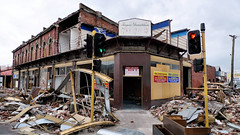
Aftermath of September 4th Earthquake in Canterbury. Shops on Colombo Street in Christchurch - damaged in earthquake and then partially demolished to reduce risk from unstable materials which might otherwise be dislodged in strong winds or subsequent aftershocks. The 1590 aftershocks recorded to date have continued to cause further damage.
Ground Motion Simulation Validation using Small-to-Moderate Magnitude Even…
Research papers, University of Canterbury Library
This poster presents work to date on ground motion simulation validation and inversion for the Canterbury, New Zealand region. Recent developments have focused on the collection of different earthquake sources and the verification of the SPECFEM3D software package in forward and inverse simulations. SPECFEM3D is an open source software package which simulates seismic wave propagation and performs adjoint tomography based upon the spectral-element method. Figure 2: Fence diagrams of shear wave velocities highlighting the salient features of the (a) 1D Canterbury velocity model, and (b) 3D Canterbury velocity model. Figure 5: Seismic sources and strong motion stations in the South Island of New Zealand, and corresponding ray paths of observed ground motions. Figure 3: Domain used for the 19th October 2010 Mw 4.8 case study event including the location of the seismic source and strong motion stations. By understanding the predictive and inversion capabilities of SPECFEM3D, the current 3D Canterbury Velocity Model can be iteratively improved to better predict the observed ground motions. This is achieved by minimizing the misfit between observed and simulated ground motions using the built-in optimization algorithm. Figure 1 shows the Canterbury Velocity Model domain considered including the locations of small-to-moderate Mw events [3-4.5], strong motion stations, and ray paths of observed ground motions. The area covered by the ray paths essentially indicates the area of the model which will be most affected by the waveform inversion. The seismic sources used in the ground motion simulations are centroid moment tensor solutions obtained from GeoNet. All earthquake ruptures are modelled as point sources with a Gaussian source time function. The minimum Mw limit is enforced to ensure good signal-to-noise ratio and well constrained source parameters. The maximum Mw limit is enforced to ensure the point source approximation is valid and to minimize off-fault nonlinear effects.
Sam Butcher's LEGO Cathedral, Photograph 52
Images, UC QuakeStudies
A photograph of components of a model of the ChristChurch Cathedral being built from LEGO by Sam Butcher. Sam comments "Fixing a large variety of bits that were wrong/annoying/cheating (not purist) about the last model. The new one is set AFTER the Feb 22 earthquake. This newer, and much stronger model is also completely modular for easier transport. Obviously still a WIP, I'm currently waiting for a pretty large bricklink order at the moment, and will probably need to place a couple more after that to".
Sam Butcher's LEGO Cathedral, Photograph 51
Images, UC QuakeStudies
A photograph of components of a model of the ChristChurch Cathedral being built from LEGO by Sam Butcher. Sam comments "Fixing a large variety of bits that were wrong/annoying/cheating (not purist) about the last model. The new one is set AFTER the Feb 22 earthquake. This newer, and much stronger model is also completely modular for easier transport. Obviously still a WIP, I'm currently waiting for a pretty large bricklink order at the moment, and will probably need to place a couple more after that too. First few modules in place".
Sam Butcher's LEGO Cathedral, Photograph 50
Images, UC QuakeStudies
A photograph of components of a model of the ChristChurch Cathedral being built from LEGO by Sam Butcher. Sam comments "Fixing a large variety of bits that were wrong/annoying/cheating (not purist) about the last model. The new one is set AFTER the Feb 22 earthquake. This newer, and much stronger model is also completely modular for easier transport. Obviously still a WIP, I'm currently waiting for a pretty large bricklink order at the moment, and will probably need to place a couple more after that too. Modules ready to be pinned together".
What caused the spatial variability of strong ground motions near the epic…
Research papers, University of Canterbury Library
During the 2011 M7.8 Kaikōura earthquake, ground motions recorded near the epicentre showed a significant spatial variation. The Te Mara farm (WTMC) station, the nearest to the epicentre, recorded 1g and 2.7g of horizontal and vertical peak ground accelerations (PGA), respectively. The nearby Waiu Gorge (WIGC) station recorded a horizontal PGA of 0.8g. Interestingly, however, the Culverden Airlie Farm (CULC) station that was very closely located to WIGC recorded a horizontal PGA of only 0.25g. This poster demonstrates how the local geological condition could have contributed to the spatially variable ground motions observed in the North Canterbury, based on the results of recently conducted geophysical investigations. The surficial geology of this area is dominated by alluvial gravel deposits with traces of silt. A borehole log showed that the thickness of the sediments at WTMC is over 76 metres. Interestingly, the shear wave velocity (Vs) profiles obtained from the three strong motion sites suggest unusually high shear wave velocity of the gravelly sediments. The velocity of sediments and the lack of clear peaks in the horizontal-to-vertical (H/V) spectral ratio at WTMC suggest that the large ground motion observed at this station was likely caused by the proximity of the station to the causative fault itself; the site effect was likely insignificant. Comparisons of H/V spectral ratios and Vs profiles suggest that the sediment thickness is much smaller at WIGC compared with CULC; the high PGA at WIGC was likely influenced by the high-frequency amplification caused by the response of shallow sediments.
Sam Butcher's LEGO Cathedral, Photograph 44
Images, UC QuakeStudies
A photograph of components of a model of the ChristChurch Cathedral being built from LEGO by Sam Butcher. Sam comments "Fixing a large variety of bits that were wrong/annoying/cheating (not purist) about the last model. The new one is set AFTER the Feb 22 earthquake. This newer, and much stronger model is also completely modular for easier transport. Obviously still a WIP, I'm currently waiting for a pretty large bricklink order at the moment, and will probably need to place a couple more after that too. Back on the new technical design for the Cathedral Rose Window".
Sam Butcher's LEGO Cathedral, Photograph 42
Images, UC QuakeStudies
A photograph of components of a model of the ChristChurch Cathedral being built from LEGO by Sam Butcher. Sam comments "Fixing a large variety of bits that were wrong/annoying/cheating (not purist) about the last model. The new one is set AFTER the Feb 22 earthquake. This newer, and much stronger model is also completely modular for easier transport. Obviously still a WIP, I'm currently waiting for a pretty large bricklink order at the moment, and will probably need to place a couple more after that too. Front on the new technical design for the Cathedral Rose Window".
Sam Butcher's LEGO Cathedral, Photograph 43
Images, UC QuakeStudies
A photograph of components of a model of the ChristChurch Cathedral being built from LEGO by Sam Butcher. Sam comments "Fixing a large variety of bits that were wrong/annoying/cheating (not purist) about the last model. The new one is set AFTER the Feb 22 earthquake. This newer, and much stronger model is also completely modular for easier transport. Obviously still a WIP, I'm currently waiting for a pretty large bricklink order at the moment, and will probably need to place a couple more after that too. Side of the new technical design for the Cathedral Rose Window".
Sam Butcher's LEGO Cathedral, Photograph 48
Images, UC QuakeStudies
A photograph of components of a model of the ChristChurch Cathedral being built from LEGO by Sam Butcher. Sam comments "Fixing a large variety of bits that were wrong/annoying/cheating (not purist) about the last model. The new one is set AFTER the Feb 22 earthquake. This newer, and much stronger model is also completely modular for easier transport. Obviously still a WIP, I'm currently waiting for a pretty large bricklink order at the moment, and will probably need to place a couple more after that too. The new base, which breaks into two sections each 48x70 studs".
Sam Butcher's LEGO Cathedral, Photograph 49
Images, UC QuakeStudies
A photograph of components of a model of the ChristChurch Cathedral being built from LEGO by Sam Butcher. Sam comments "Fixing a large variety of bits that were wrong/annoying/cheating (not purist) about the last model. The new one is set AFTER the Feb 22 earthquake. This newer, and much stronger model is also completely modular for easier transport. Obviously still a WIP, I'm currently waiting for a pretty large bricklink order at the moment, and will probably need to place a couple more after that too. The new base, which breaks into two sections each 48x70 studs".
Sam Butcher's LEGO Cathedral, Photograph 46
Images, UC QuakeStudies
A photograph of components of a model of the ChristChurch Cathedral being built from LEGO by Sam Butcher. Sam comments "Fixing a large variety of bits that were wrong/annoying/cheating (not purist) about the last model. The new one is set AFTER the Feb 22 earthquake. This newer, and much stronger model is also completely modular for easier transport. Obviously still a WIP, I'm currently waiting for a pretty large bricklink order at the moment, and will probably need to place a couple more after that too. Here you can see a couple of aspects of how the model is put together. The technique used proved - from what I tried - to be the best and strongest way to do it".
Sam Butcher's LEGO Cathedral, Photograph 47
Images, UC QuakeStudies
A photograph of components of a model of the ChristChurch Cathedral being built from LEGO by Sam Butcher. Sam comments "Fixing a large variety of bits that were wrong/annoying/cheating (not purist) about the last model. The new one is set AFTER the Feb 22 earthquake. This newer, and much stronger model is also completely modular for easier transport. Obviously still a WIP, I'm currently waiting for a pretty large bricklink order at the moment, and will probably need to place a couple more after that too. Here you can see a couple of aspects of how the model is put together. The technique used proved - from what I tried - to be the best and strongest way to do it".
Sam Butcher's LEGO Cathedral, Photograph 45
Images, UC QuakeStudies
A photograph of components of a model of the ChristChurch Cathedral being built from LEGO by Sam Butcher. Sam comments "Fixing a large variety of bits that were wrong/annoying/cheating (not purist) about the last model. The new one is set AFTER the Feb 22 earthquake. This newer, and much stronger model is also completely modular for easier transport. Obviously still a WIP, I'm currently waiting for a pretty large bricklink order at the moment, and will probably need to place a couple more after that too. Here you can see a couple of aspects of how the model is put together. The technique used proved - from what I tried - to be the best and strongest way to do it".
Geologic and geomorphic influence on the spatial extent of lateral spreadi…
Research papers, University of Canterbury Library
Liquefaction-induced lateral spreading during earthquakes poses a significant hazard to the built environment, as observed in Christchurch during the 2010 to 2011 Canterbury Earthquake Sequence (CES). It is critical that geotechnical earthquake engineers are able to adequately predict both the spatial extent of lateral spreads and magnitudes of associated ground movements for design purposes. Published empirical and semi-empirical models for predicting lateral spread displacements have been shown to vary by a factor of <0.5 to >2 from those measured in parts of Christchurch during CES. Comprehensive post- CES lateral spreading studies have clearly indicated that the spatial distribution of the horizontal displacements and extent of lateral spreading along the Avon River in eastern Christchurch were strongly influenced by geologic, stratigraphic and topographic features.
Simulation and Validation of Topographic Effectds on Mt Pleasant, Christch…
Research papers, University of Canterbury Library
Damage distribution maps from strong earthquakes and recorded data from field experiments have repeatedly shown that the ground surface topography and subsurface stratigraphy play a decisive role in shaping the ground motion characteristics at a site. Published theoretical studies qualitatively agree with observations from past seismic events and experiments; quantitatively, however, they systematically underestimate the absolute level of topographic amplification up to an order of magnitude or more in some cases. We have hypothesized in previous work that this discrepancy stems from idealizations of the geometry, material properties, and incident motion characteristics that most theoretical studies make. In this study, we perform numerical simulations of seismic wave propagation in heterogeneous media with arbitrary ground surface geometry, and compare results with high quality field recordings from a site with strong surface topography. Our goal is to explore whether high-fidelity simulations and realistic numerical models can – contrary to theoretical models – capture quantitatively the frequency and amplitude characteristics of topographic effects. For validation, we use field data from a linear array of nine portable seismometers that we deployed on Mount Pleasant and Heathcote Valley, Christchurch, New Zealand, and we compute empirical standard spectral ratios (SSR) and single-station horizontal-to-vertical spectral ratios (HVSR). The instruments recorded ambient vibrations and remote earthquakes for a period of two months (March-April 2017). We next perform two-dimensional wave propagation simulations using the explicit finite difference code FLAC. We construct our numerical model using a high-resolution (8m) Digital Elevation Map (DEM) available for the site, an estimated subsurface stratigraphy consistent with the geomorphology of the site, and soil properties estimated from in-situ and non-destructive tests. We subject the model to in-plane and out-of-plane incident motions that span a broadband frequency range (0.1-20Hz). Numerical and empirical spectral ratios from our blind prediction are found in very good quantitative agreement for stations on the slope of Mount Pleasant and on the surface of Heathcote Valley, across a wide range of frequencies that reveal the role of topography, soil amplification and basin edge focusing on the distribution of ground surface motion.
Investigation of Systematic Ground Motion Effects through Ground Motion Si…
Research papers, University of Canterbury Library
1. Background and Objectives This poster presents results from ground motion simulations of small-to-moderate magnitude (3.5≤Mw≤5.0) earthquake events in the Canterbury, New Zealand region using the Graves and Pitarka (2010,2015) methodology. Subsequent investigation of systematic ground motion effects highlights the prediction bias in the simulations which are also benchmarked against empirical ground motion models (e.g. Bradley (2013)). In this study, 144 earthquake ruptures, modelled as point sources, are considered with 1924 quality-assured ground motions recorded across 45 strong motion stations throughout the Canterbury region, as shown in Figure 1. The majority of sources are Mw≥4.0 and have centroid depth (CD) 10km or shallower. Earthquake source descriptions were obtained from the GeoNet New Zealand earthquake catalogue. The ground motion simulations were performed within a computational domain of 140km x 120km x 46km with a finite difference grid spacing of 0.1km. The low-frequency (LF) simulations utilize the 3D Canterbury Velocity Model while the high-frequency (HF) simulations utilize a generic regional 1D velocity model. In the LF simulations, a minimum shear wave velocity of 500m/s is enforced, yielding a maximum frequency of 1.0Hz.
Governing community resilience: Interconnections between community resilie…
Research papers, University of Canterbury Library
The lived reality of the 2010-2011 Canterbury earthquakes and its implications for the Waimakariri District, a small but rapidly growing district (third tier of government in New Zealand) north of Christchurch, can illustrate how community well-being, community resilience, and community capitals interrelate in practice generating paradoxical results out of what can otherwise be conceived as a textbook ‘best practice’ case of earthquake recovery. The Waimakariri District Council’s integrated community based recovery framework designed and implemented post-earthquakes in the District was built upon strong political, social, and moral capital elements such as: inter-institutional integration and communication, participation, local knowledge, and social justice. This approach enabled very positive community outputs such as artistic community interventions of the urban environment and communal food forests amongst others. Yet, interests responding to broader economic and political processes (continuous central government interventions, insurance and reinsurance processes, changing socio-cultural patterns) produced a significant loss of community capitals (E.g.: social fragmentation, participation exhaustion, economic leakage, etc.) which simultaneously, despite local Council and community efforts, hindered community well-being in the long term. The story of the Waimakariri District helps understand how resilience governance operates in practice where multi-scalar, non-linear, paradoxical, dynamic, and uncertain outcomes appear to be the norm that underpins the construction of equitable, transformative, and sustainable pathways towards the future.
People in Disasters Conference - Resilience, Poverty, and Seismic Culture
Videos, UC QuakeStudies
A video of a presentation by Richard Conlin during the Community Resilience Stream of the 2016 People in Disasters Conference. The presentation is titled, "Resilience, Poverty, and Seismic Culture".The abstract for this presentation reads as follows: A strategy of resilience is built around the recognition that effective emergency response requires community involvement and mobilization. It further recognizes that many of the characteristics that equip communities to respond most effectively to short term emergencies are also characteristics that build strong communities over the long term. Building resilient communities means integrating our approaches to poverty, community engagement, economic development, and housing into a coherent strategy that empowers community members to engage with each other and with other communities. In this way, resilience becomes a complementary concept to sustainability. This requires an asset-based change strategy where external agencies meet communities where they are, in their own space, and use collective impact approaches to work in partnership. This also requires understanding and assessing poverty, including physical, financial, and social capital in their myriad manifestations. Poverty is not exclusively a matter of class. It is a complex subject, and different communities manifest multiple versions of poverty, which must be respected and understood through the asset-based lens. Resilience is a quality of a community and a system, and develops over time as a result of careful analysis of strengths and vulnerabilities and taking actions to increase competencies and reduce risk situations. Resilience requires maintenance and must be developed in a way that includes practicing continuous improvement and adaptation. The characteristics of a resilient community include both physical qualities and 'soft infrastructure', such as community knowledge, resourcefulness, and overall health. This presentation reviews the experience of some earlier disasters, outlines a working model of how emergency response, resilience, and poverty interact and can be addressed in concert, and concludes with a summary of what the 2010 Chilean earthquake tells us about how a 'seismic culture' can function effectively in communities even when government suffers from unexpected shortcomings.
The consumption of chaos: From the charm of chaos to the tedium of order …
Research papers, Lincoln University
Prior to the devastating 2010 and 2011 earthquakes, parts of the CBD of Christchurch, New Zealand were undergoing revitalisation incorporating aspects of adaptive reuse and gentrification. Such areas were often characterised by a variety of bars, restaurants, and retail outlets of an “alternative” or “bohemian” style. These early 20th century buildings also exhibited relatively low rents and a somewhat chaotic and loosely planned property development approach by small scale developers. Almost all of these buildings were demolished following the earthquakes and a cordon placed around the CBD for several years. A paper presented at the ERES conference in 2013 presented preliminary results, from observation of post-earthquake public meetings and interviews with displaced CBD retailers. This paper highlighted a strongly held fear that the rebuild of the central city, then about to begin, would result in a very different style and cost structure from that which previously existed. As a result, permanent exclusion from the CBD of the types of businesses that previously characterised the successfully revitalised areas would occur. Five years further on, new CBD retail and office buildings have been constructed, but large areas of land between them remain vacant and the new buildings completed are often having difficulty attracting tenants. This paper reports on the further development of this long-term Christchurch case study and examines if the earlier predictions of the displaced retailers are coming true, in that a new CBD that largely mimics a suburban mall in style and tenancy mix, inherently loses some of its competitive advantage?
People in Disasters Conference - A Systematic Review of Compassion Fatigue…
Videos, UC QuakeStudies
A video of a presentation by Jai Chung during the Staff and Patients Stream of the 2016 People in Disasters Conference. The presentation is titled, "A Systematic Review of Compassion Fatigue of Nurses During and After the Canterbury Earthquakes".The abstract for the presentation reads as follows: Limited research is currently available about compassion fatigue of health professionals during and after disasters in New Zealand. The purpose of this systematic literature review was to provide a comprehensive outline of existing research. National and international literature was compared and contrasted to determine the importance of recognising compassion fatigue during and after disasters. Health professionals responding to disasters have played an important role in saving lives. Especially, during and after the Canterbury earthquakes, many health professionals cared for the traumatized public of the region. When responding to and caring for many distressed people, health professionals - particularly nurses - may strongly empathise with people's pain, fear, and distress. Consequently, they can be affected both emotionally and physically. Nurses may experience intensive and extreme distress and trauma directly and indirectly. Physical exhaustion can arise quickly. Emotional exhaustion such as hopelessness and helplessness may lead to nurses losing the ability to nurture and care for people during disasters. This can lead to compassion fatigue. It is important to understand how health professionals, especially nurses, experience compassion fatigue in order to help them respond to disasters appropriately. International literature explains the importance of recognising compassion fatigue in nursing, and explores different coping mechanisms that assist nurses overcome or prevent this health problem. In contrast, New Zealand literature is limited to experiences of nurses' attitudes in responding to natural disasters. In light of this, this literature review will help to raise awareness about the importance of recognising and addressing symptoms of compassion fatigue in a profession such as nursing. Gaps within the research will also be identified along with recommendations for future research in this area, especially from a New Zealand perspective. Please note that due to a recording error the sound cuts out at 9 minutes.
Disasters and investment: Assessing the performance of the underlying econ…
Research papers, Lincoln University
Disasters are often followed by a large-scale stimulus supporting the economy through the built environment, which can last years. During this time, official economic indicators tend to suggest the economy is doing well, but as activity winds down, the sentiment can quickly change. In response to the damaging 2011 earthquakes in Canterbury, New Zealand, the regional economy outpaced national economic growth rates for several years during the rebuild. The repair work on the built environment created years of elevated building activity. However, after the peak of the rebuilding activity, as economic and employment growth retracts below national growth, we are left with the question of how the underlying economy performs during large scale stimulus activity in the built environment. This paper assesses the performance of the underlying economy by quantifying the usual, demand-driven level of building activity at this time. Applying an Input–Output approach and excluding the economic benefit gained from the investment stimulus reveals the performance of the underlying economy. The results reveal a strong growing underlying economy, and while convergence was expected as the stimulus slowed down, the results found that growth had already crossed over for some time. The results reveal that the investment stimulus provides an initial 1.5% to 2% growth buffer from the underlying economy before the growth rates cross over. This supports short-term economic recovery and enables the underlying economy to transition away from a significant rebuild stimulus. Once the growth crosses over, five years after the disaster, economic growth in the underlying economy remains buoyant even if official regional economic data suggest otherwise.
People in Disasters Conference - Understanding Immediate Human Behaviour t…
Videos, UC QuakeStudies
A video of a presentation by Professor David Johnston during the fourth plenary of the 2016 People in Disasters Conference. Johnston is a Senior Scientist at GNS Science and Director of the Joint Centre for Disaster Research in the School of Psychology at Massey University. The presentation is titled, "Understanding Immediate Human Behaviour to the 2010-2011 Canterbury Earthquake Sequence, Implications for injury prevention and risk communication".The abstract for the presentation reads as follows: The 2010 and 2011 Canterbury earthquake sequences have given us a unique opportunity to better understand human behaviour during and immediately after an earthquake. On 4 September 2010, a magnitude 7.1 earthquake occurred near Darfield in the Canterbury region of New Zealand. There were no deaths, but several thousand people sustained injuries and sought medical assistance. Less than 6 months later, a magnitude 6.2 earthquake occurred under Christchurch City at 12:51 p.m. on 22 February 2011. A total of 182 people were killed in the first 24 hours and over 7,000 people injured overall. To reduce earthquake casualties in future events, it is important to understand how people behaved during and immediately after the shaking, and how their behaviour exposed them to risk of death or injury. Most previous studies have relied on an analysis of medical records and/or reflective interviews and questionnaire studies. In Canterbury we were able to combine a range of methods to explore earthquake shaking behaviours and the causes of injuries. In New Zealand, the Accident Compensation Corporation (a national health payment scheme run by the government) allowed researchers to access injury data from over 9,500 people from the Darfield (4 September 2010) and Christchurch (22 February 2011 ) earthquakes. The total injury burden was analysed for demography, context of injury, causes of injury, and injury type. From the injury data inferences into human behaviour were derived. We were able to classify the injury context as direct (immediate shaking of the primary earthquake or aftershocks causing unavoidable injuries), and secondary (cause of injury after shaking ceased). A second study examined people's immediate responses to earthquakes in Christchurch New Zealand and compared responses to the 2011 earthquake in Hitachi, Japan. A further study has developed a systematic process and coding scheme to analyse earthquake video footage of human behaviour during strong earthquake shaking. From these studies a number of recommendations for injury prevention and risk communication can be made. In general, improved building codes, strengthening buildings, and securing fittings will reduce future earthquake deaths and injuries. However, the high rate of injuries incurred from undertaking an inappropriate action (e.g. moving around) during or immediately after an earthquake suggests that further education is needed to promote appropriate actions during and after earthquakes. In New Zealand - as in US and worldwide - public education efforts such as the 'Shakeout' exercise are trying to address the behavioural aspects of injury prevention.