

Search
found 97193 results
Images for New zealand; more images...
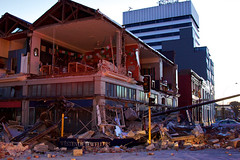


Photograph of the Cranmer Centre, 40 Armagh Street (248)
Images, UC QuakeStudies
A photograph of a piece of masonry removed from the Cranmer Centre.
Photograph of the Cranmer Centre, 40 Armagh Street (279)
Images, UC QuakeStudies
A photograph of a detail of the Cranmer Centre.
Photograph of 35 Cambridge Terrace (2)
Images, UC QuakeStudies
A photograph of 35 Cambridge Terrace.
Photograph of 128 Manchester Street (4)
Images, UC QuakeStudies
A photograph of the earthquake damage to 128 Manchester Street.
Photograph of Ironside House, 381 Montreal Street (23)
Images, UC QuakeStudies
A photograph of the earthquake damage around a window of Ironside House on Montreal Street.
Photograph of 109 Cashel Street (6)
Images, UC QuakeStudies
A photograph of the earthquake damage to 109 Cashel Street.
Photograph of the Cranmer Centre, 40 Armagh Street (83)
Images, UC QuakeStudies
A photograph of rubble from the partially-demolished Cranmer Centre.
Building Record Form for former Canterbury Horse Bazaar, 141 Lichfield Str…
Articles, UC QuakeStudies
Building Record Form for former Canterbury Horse Bazaar, 141 Lichfield Street, Christchurch
Photograph of 31 London Street (2)
Images, UC QuakeStudies
A photograph of a window of 31 London Street.
Photograph of the Cranmer Centre, 40 Armagh Street (211)
Images, UC QuakeStudies
A photograph of earthquake damage to the wall above a window of the Cranmer Centre.
Photograph of the Cranmer Centre, 40 Armagh Street (483)
Images, UC QuakeStudies
A photograph of an excavator demolishing the Cranmer Centre.
Photograph of 170 Tuam Street (10)
Images, UC QuakeStudies
A photograph of 170 Tuam Street.
Photograph of the Canterbury Provincial Chambers Buildings on Durham Stree…
Images, UC QuakeStudies
An aerial photograph of the earthquake damage to a window of the Canterbury Provincial Chambers Buildings on Durham Street.
Photograph of 127-139 Manchester Street (1)
Images, UC QuakeStudies
A photograph of the earthquake damage to 127-133 Manchester Street.
Note on the analysis of a mineral water from the Otira Gorge
Research papers, Lincoln University
The sample of water referred to in the present note was collected by the writer on the 21st January, 1889, in the Otira Gorge, from a spring which is stated to have been first discovered shortly after the earthquake of the 1st September, 1888. From the results obtained this water might be termed siliceous and sulphurous. It is essentially different from the water from the Hanmer Springs, and pertains more to the character of the waters of the Rotorua district. It differs, however, from these waters in having only a portion of its carbonic anhydride replaced by silica, and in containing less dissolved matter.
Canterbury Earthquake - Jessica Maddock
Audio, Radio New Zealand
Radio New Zealand reporter Jessica Maddock reports from the Christchurch Central City cordon.
Canterbury Earthquake - Don Rood
Audio, Radio New Zealand
Radio New Zealand's Head of News, Don Rood, has just arrived in Christchurch.
Canterbury Earthquake - Jessica Maddock
Audio, Radio New Zealand
Radio New Zealand reporter Jessica Maddock has been to a Civil Defense Briefing.
Christchurch Press Infographic: 10 February 2012 (2)
Images, UC QuakeStudies
An infographic comparing unemployment rates in Canterbury to the rest of New Zealand.
Koen Broekema's Photograph 013
Images, UC QuakeStudies
The New Zealand flag flutters above the damaged stonework of Christ Church Cathedral.
Fairfax Video, September 2010 (27)
Videos, UC QuakeStudies
A video of members of the New Zealand Police and the New Zealand Army guarding cordons in the Christchurch central city after the 4 September 2010 earthquake. The video also includes footage of a helicopter flying over the central city.
Winter, Mark 1958- :Christchurch - the new tear. 3 January 2012
Images, Alexander Turnbull Library
The cartoon shows the word 'Christchurch' fractured by earthquake. Text above reads 'The new tear(s)'. A second version has the text in the singular 'The new tear'. Context: In spite of Christchurch's great hopes for a new year without earthquakes, there have been numerous quakes and aftershocks. A wordplay on 'new year' and 'new tear' - that is weeping with fear and dismay. Two versions of this cartoon are available Quantity: 2 digital cartoon(s).
Former Christchurch residents have new lives in new cities
Audio, Radio New Zealand
Ready or not for an earthquake, many former Christchurch residents have left canterbury for what they describe as more stable pastures.
Christchurch Press Infographic: 31 March 2012 (6)
Images, UC QuakeStudies
A chart comparing electricity price increases in Christchurch to the rest of New Zealand.
Christchurch Press Infographic: 18 January 2012 (4)
Images, UC QuakeStudies
A graph comparing domestic trading activity in Canterbury to the rest of New Zealand.
Christchurch Press Infographic: 13 July 2011 (2)
Images, UC QuakeStudies
A graph comparing EFT-POS spending in Canterbury to the rest of New Zealand.
Canterbury Earthquake - Jessica Maddock
Audio, Radio New Zealand
Radio New Zealand reporter Jessica Maddock reports on a briefing by Mayor Bob Parker.
Vulnerability to Seismic Hazards in Coastal and Riverside Communities, map…
Images, UC QuakeStudies
A map of the tectonic plate boundary of the alpine fault in New Zealand.
Photograph number UC 10-0490-53
Images, UC QuakeStudies
Staff Sergeant Manu from the New Zealand Army helping organise the Student Volunteer Army.
Photograph number UC 10-0490-54
Images, UC QuakeStudies
Staff Sergeant Manu from the New Zealand Army helping organise the Student Volunteer Army.