
Search
found 3469 results
Images for Earthquake Christchurch; more images...


Lyttelton Library re-opening
Images, eqnz.chch.2010
Photos taken in Lyttelton on April 16 at the official re-opening ceremony following the February 22 earthquake. Cake was served, and Greg Malcolm entertained. File reference: CCL-2011-04-16-Lyttelton-Library-re-opening-P1110831 From the collection of Christchurch City Lib...
London Street demolitions
Images, eqnz.chch.2010
Photos taken in Lyttelton on April 15 showing the demolition of the Volcano Cafe, the Lava Bar, Lyttelton Fisheries and the coastal living design store following the February 22 earthquake. File reference: CCL-2011-04-15-London-Street-Demolition-IMG_0120 From the collection of
London Street demolitions
Images, eqnz.chch.2010
Photos taken in Lyttelton on April 15 showing the demolition of the Volcano Cafe, the Lava Bar, Lyttelton Fisheries and the coastal living design store following the February 22 earthquake. File reference: CCL-2011-04-15-London-Street-Demolition-IMG_0125 From the collection of
Observatory Tower Photograph 13
Images, UC QuakeStudies
A close-up photograph of parts of the Townsend Telescope recovered from the rubble of the Observatory tower. The telescope was housed in the tower at the Christchurch Arts Centre. It was severely damaged when the tower collapsed during the 22 February 2011 earthquake.
Observatory Tower Photograph 18
Images, UC QuakeStudies
A photograph of the earthquake damage to the second story of the Observatory tower at the Christchurch Arts Centre. The front of the storey has collapsed, exposing the inside. A tarpaulin has been draped over the top and the roof of the building behind.
Rebekah Rogers WEMO Photograph 107
Images, UC QuakeStudies
A photograph of campervans parked in Hagley Park. These were used as temporary accommodation for many emergency management personnel who travelled to Christchurch after the 22 February 2011 earthquake.
Rebekah Rogers WEMO Photograph 100
Images, UC QuakeStudies
A photograph of campervans parked in Hagley Park. These were used as temporary accommodation for many emergency management personnel who travelled to Christchurch after the 22 February 2011 earthquake.
Rebekah Rogers WEMO Photograph 099
Images, UC QuakeStudies
A photograph of campervans parked in Hagley Park. These were used as temporary accommodation for many emergency management personnel who travelled to Christchurch after the 22 February 2011 earthquake.
WEMO ERT Set 1 - March 2011 - Photograph 07
Images, UC QuakeStudies
A photograph of the earthquake damage to a room inside a house in Christchurch. Large sections of the plaster have crumbled from the walls, revealing the brick wall underneath.
Rebekah Rogers WEMO Photograph 102
Images, UC QuakeStudies
A photograph of campervans parked in Hagley Park. These were used as temporary accommodation for many emergency management personnel who travelled to Christchurch after the 22 February 2011 earthquake.
20100906-151302.jpg
Images, eqnz.chch.2010
None
20100906-151248.jpg
Images, eqnz.chch.2010
None
20100906-124233.jpg
Images, eqnz.chch.2010
None
20100906-151327.jpg
Images, eqnz.chch.2010
None
20100906-124228.jpg
Images, eqnz.chch.2010
None
20100906-113431.jpg
Images, eqnz.chch.2010
None
20100906-113342.jpg
Images, eqnz.chch.2010
None
20100906-113522.jpg
Images, eqnz.chch.2010
None
Nic Johns and Mark Osborne WEMO Photograph 068
Images, UC QuakeStudies
A photograph of a panaroma of Christchurch with Spencer Park, Parklands Library, QEII Park, Bottle Lake Forest, Cowles Stadium, Animal Control, and the Waste Water Treatment Plant labelled. The panaroma is on the wall of the temporary Civil Defence headquarters set up at the Christchurch Art Gallery after the 4 September 2010 earthquake.
Identifying inanga spawning sites in plans: options for addressing post-qu…
Research papers, University of Canterbury Library
The purpose of this assessment is to compare records of known inanga spawning sites in the waterways of Ōtautahi Christchurch from before and after the Canterbury earthquakes, with particular emphasis on information used in the design of planning methods for spawning site protection.
Housing a Different Christchurch Rebuild
Research papers, The University of Auckland Library
This thesis revisits the topic of earthquake recovery in Christchurch City more than a decade after the Canterbury earthquakes. Despite promising visions of a community reconnected and a sustainable and liveable city, significant portions of the city’s core – the Red Zone – remain dilapidated and “eerily empty”. At the same time, new developments in other areas have proven to be alienated or underutilised. Currently, the Canterbury Earthquake Recovery Authority’s plans for the rebuilding highlight the delivery of more residential housing to re-populate the city centre. However, prevalent approaches to housing development in Christchurch are ineffective for building an inclusive and active community. Hence, the central inquiry of the thesis is how the development of housing complexes can revitalise the Red Zone within the Christchurch city centre. The inquiry has been carried out through a research-through-design methodology, recognising the importance of an in-depth investigation that is contextualised and combined with the intuition and embodied knowledge of the designer. The investigation focuses on a neglected site in the Red Zone in the heart of Christchurch city, with significant Victorian and Edwardian Baroque heritage buildings, including Odeon Theatre, Lawrie & Wilson Auctioneers, and Sol Square, owned by The Regional Council Environment Canterbury. The design inquiry argues, develops, and is carried through a place-assemblage lens to housing development for city recovery, which recognizes the significance of socially responsive architecture that explores urban renewal by forging connections within the social network. Therefore, place-assemblage criteria and methods for developing socially active and meaningful housing developments are identified. Firstly, this thesis argues that co-living housing models are more focused on people relations and collective identity than the dominant developer-driven housing rebuilds, as they prioritise conduits for interaction and shared social meaning and practices. Secondly, the adaptive reuse of derelict heritage structures is proposed to reinvigorate the urban fabric, as heritage is seen to be conceived as and from a social assemblage of people. The design is realised by the principles outlined in the ICOMOS charter, which involves incorporating the material histories of existing structures and preserving the intangible heritage of the site by ensuring the continuity of cultural practices. Lastly, design processes and methods are also vital for place-sensitive results, which pay attention to the site’s unique characteristics to engage with local stakeholders and communities. The research explores place-assemblage methods of photographic extraction, the drawing of story maps, precedent studies, assemblage maps, bricolages, and paper models, which show an assembly of layers that piece together the existing heritage, social conduits, urban commons and housing to conceptualise the social network within its place.
BeckerFraserPhotos April 2012 photograph 315
Images, UC QuakeStudies
A notice on the fence outside the CTV site on Madras Street. The notice reads, "Please respect this site. In recognition of the special significance this site holds for the people of our city and all those affected by the earthquakes, the Christchurch City Council is working with Canterbury Museum to preserve aspects of our remembering. Tributes may be left at this site. Older tributes will be removed for archiving by the Canterbury Museum to become part of the city's memory of the Canterbury Earthquakes. Organic materials will be composted and used in the city's gardens. Canterbury Museum. Christchurch City Council".
Observatory Tower Photograph 11
Images, UC QuakeStudies
A photograph of the largest section of the Townsend Telescope recovered from the rubble of the Observatory tower. The telescope was housed in the tower at the Christchurch Arts Centre. It was severely damaged when the tower collapsed during the 22 February 2011 earthquake.
WEMO ERT Set 1 - March 2011 - Photograph 27
Images, UC QuakeStudies
A photograph of a member of the Wellington Emergency Management Office Emergency Response Team standing among broken furniture and rubble in the room of an earthquake-damaged house in Christchurch.
Jim Baltaxe WEMO Photograph 003
Images, UC QuakeStudies
A photograph of volunteers from the Wellington Emergency Management Office in Wellington Airport. The volunteers travelled to Christchurch after the 22 February 2011 earthquake to help with the emergency response.
Jim Baltaxe WEMO Photograph 002
Images, UC QuakeStudies
A photograph of volunteers from the Wellington Emergency Management Office in Wellington Airport. The volunteers travelled to Christchurch after the 22 February 2011 earthquake to help with the emergency response.
WEMO ERT Set 1 - March 2011 - Photograph 26
Images, UC QuakeStudies
A photograph of a member of the Wellington Emergency Management Office Emergency Response Team standing amongst broken furniture and rubble in the room of an earthquake-damaged house in Christchurch.
WEMO ERT Set 1 - March 2011 - Photograph 162
Images, UC QuakeStudies
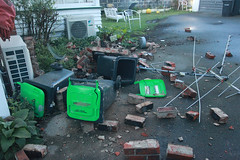
A photograph of the earthquake damage to a house in the Christchurch central city. The bricks walls of the building have collapsed and the bricks have spilt into the garden.
Sylviane Lebon WEMO Photograph 6
Images, UC QuakeStudies
A photograph of the earthquake damage to the curb of a street in Christchurch. The curb has cracked in two places and slumped, exposing the earth beneath the grass turf.
Photograph by Jennifer Middendorf 276
Images, UC QuakeStudies
A string quartet from Christchurch Girls High School plays on the riverbank before the River of Flowers event held in Riccarton Bush, commemorating the second anniversary of the 22 February earthquake.