
Search
found 3469 results
Images for Earthquake Christchurch; more images...


Nic Johns and Mark Osborne WEMO Photograph 121
Images, UC QuakeStudies
A photograph of volunteers from the Wellington Emergency Management Office standing on a pile of bricks from an earthquake-damaged building in the Christchurch central city.
Crowd on The Grassy
Images, eqnz.chch.2010
Photos taken at the Lyttelton Community briefing held on March 7 2011 following the magnitude 6.3 earthquake on 22 February 2011. File Ref: CCL-2011-03-07-Lyttelton-Community-Briefing-P1110625 From the collection of Christchurch City Libraries.
TV3 reporter Ali Ikram
Images, eqnz.chch.2010
Photos taken at the Lyttelton Community briefing held on March 7 2011 following the magnitude 6.3 earthquake on 22 February 2011. File Ref: CCL-2011-03-07-Lyttelton-Community-Briefing-P1110622 From the collection of Christchurch City Libraries.
Large crowd at community briefing
Images, eqnz.chch.2010
Photos taken at the Lyttelton Community briefing held on March 7 2011 following the magnitude 6.3 earthquake on 22 February 2011. File Ref: CCL-2011-03-07-Lyttelton-Community-Briefing-P1110619 From the collection of Christchurch City Libraries.
Photographer in the crowd
Images, eqnz.chch.2010
Photos taken at the Lyttelton Community briefing held on March 7 2011 following the magnitude 6.3 earthquake on 22 February 2011. File Ref: CCL-2011-03-07-Lyttelton-Community-Briefing-P1110621 From the collection of Christchurch City Libraries.
Play, politics and the production of space: DIY urbanism in post-earthquak…
Research papers, The University of Auckland Library
The Canterbury earthquake sequence of 2010-2011 wrought ruptures in not only the physical landscape of Canterbury and Christchurch’s material form, but also in its social, economic, and political fabrics and the lives of Christchurch inhabitants. In the years that followed, the widespread demolition of the CBD that followed the earthquakes produced a bleak landscape of grey rubble punctuated by damaged, abandoned buildings. It was into this post-earthquake landscape that Gap Filler and other ‘transitional’ organisations inserted playful, creative, experimental projects to bring life and energy back into the CBD. This thesis examines those interventions and the development of the ‘Transitional Movement’ between July 2013 and June 2015 via the methods of walking interviews and participant observation. This critical period in Christchurch’s recovery serves as an example of what happens when do-it-yourself (DIY) urbanism is done at scale across the CBD and what urban experimentation can offer city-making. Through an understanding of space as produced, informed by Lefebvre’s thinking, I explore how these creative urban interventions manifested a different temporality to orthodox planning and demonstrate how the ‘soft’ politics of these interventions contain the potential for gentrification and also a more radical politics of the city, by creating an opening space for difference.
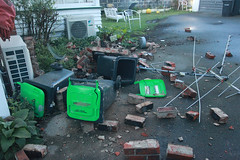
boxes down
Images, eqnz.chch.2010
None
PGC building
Images, eqnz.chch.2010
The CTV collapse is the worst and most devastating, from what I saw of the CBD yesterday.
brick fence down
Images, eqnz.chch.2010
None
WEMO ERT Set 1 - February 2011 - Photograph 60
Images, UC QuakeStudies
A photograph looking south down Colombo Street towards the earthquake-damaged ChristChurch Cathedral. A crane is sitting on the road in front of the Cathedral. In the background is a pile of rubble from the partially-demolished tower.
Observatory Tower Photograph 38
Images, UC QuakeStudies
A photograph of the earthquake-damaged Observatory tower at the Christchurch Arts Centre. The photograph was taken using a cellphone camera. The top of the tower collapsed during the 22 February 2011 earthquake. The rubble from the tower has been cleared and a tarpaulin has been placed over the top of the broken tower. Tyres have been placed on the tarpaulin to hold it down. A temporary roof has also been constructed over the tower to keep out the rain. Two vehicles are parked in front.
WEMO ERT Team Set 3 - April 2011 - Photograph 02
Images, UC QuakeStudies
A photograph of the photocopy template for the Christchurch City Council's yellow sticker. The sticker was used by the Civil Defence after the 2010 and 2011 earthquakes to indicate that a building had been inspected and that structural damage or other safety hazards had been found. The sticker states that there should be no entry to the building, 'except on essential business'. It also states that 'earthquake aftershocks present danger' and that people who enter must do so at their own risk.
BeckerFraserPhotos September 2010 photograph 027
Images, UC QuakeStudies
Cordon fencing around the Arts Centre on Worcester Boulevard. A man with a hard hats and hi-vis vest on can be. Wooden bracing has been placed on the gable on the tower to limit further earthquake damage. There is a crane sitting inside the fenced area.
WEMO ERT Set 3 - February 2011 - Photograph 268
Images, UC QuakeStudies
A photograph of earthquake damage to the ChristChurch Cathedral in Cathedral Square. The tower has been partially demolished and a pile of rubble sits in front. A Daniel Smith Industries Ltd crane is sitting to the left.
WEMO ERT Set 3 - February 2011 - Photograph 267
Images, UC QuakeStudies
A photograph of earthquake damage to the ChristChurch Cathedral in Cathedral Square. The tower has been partially demolished and a pile of rubble sits in front. A Daniel Smith Industries Ltd crane is sitting to the left.
Mike Cameron WEMO Photograph 21
Images, UC QuakeStudies
A photograph of the earthquake damage to the Chinese Methodist Church on Papanui Road. The bricks at the top of the tower have crumbled, and the wooden bracing is hanging half off the building. The spire of the tower can be seen to the left where it was moved to following the 4 September 2010 earthquake.
BeckerFraserPhotos March 2011 photograph 130
Images, UC QuakeStudies
A wooden brace holding up a window of the Cramner Centre, formerly Christchurch Girls' High School. The masonry above the window has fallen away during the earthquake.
Observatory Tower Photograph 26
Images, UC QuakeStudies
A photograph of the rubble of the Observatory tower in the South Quad of the Christchurch Arts Centre. The tower collapsed during the 22 February 2011 earthquake. Scaffolding constructed around the tower has also collapsed and is amongst the rubble.
Mike Cameron WEMO Photograph 20
Images, UC QuakeStudies
A photograph of the earthquake damage to the Christchurch Chinese Methodist Church on Papanui Road. The wall of the gable has crumbled, the bricks spilling onto the lawn below. Wire fencing has been placed around the building as a cordon.
Jim Baltaxe WEMO Photograph 014
Images, UC QuakeStudies
A photograph of emergency management personnel in the foyer of the Christchurch Art Gallery. The art gallery was used as the temporary Civil Defence headquarters after the 22 February 2011 earthquake. In the background, a cherry picker can be seen.
Jim Baltaxe WEMO Photograph 126
Images, UC QuakeStudies
A photograph of the earthquake damage to the Christchurch Chinese Methodist Church on Papanui Road. The gable wall has crumbled, the bricks and window frame falling onto the ground. Wire fencing has been placed around the building as a cordon.
Jim Baltaxe WEMO Photograph 012
Images, UC QuakeStudies
A photograph of emergency management personnel in the foyer of the Christchurch Art Gallery. The art gallery was used as the temporary Civil Defence headquarters after the 22 February 2011 earthquake. In the background, a cherry picker can be seen.
Observatory Tower Photograph 14
Images, UC QuakeStudies
A close-up photograph of parts of the Townsend Telescope recovered from the rubble of the Observatory tower. The telescope was housed in the tower at the Christchurch Arts Centre. It was severely damaged when the tower collapsed during the 22 February 2011 earthquake.
Observatory Tower Photograph 12
Images, UC QuakeStudies
A photograph of parts of the Townsend Telescope recovered from the rubble of the Observatory tower. The telescope was housed in the tower at the Christchurch Arts Centre. It was severely damaged when the tower collapsed during the 22 February 2011 earthquake.
Deb Robertson's Blog 19/11/2012: Christchurch: Trying to make sense of liv…
Articles, UC QuakeStudies
An entry from Deb Robertson's blog for 19 November 2012 entitled, "Christchurch: Trying to make sense of living here....".
20100906-124704.jpg
Images, eqnz.chch.2010
None
Homage to the Lost Spaces Photograph 4
Images, UC QuakeStudies
A photograph of Mike Hewson's installation 'Homage to the Lost Spaces' being installed on plywood covering the earthquake-damaged Cranmer Courts building.
Homage to the Lost Spaces Photograph 5
Images, UC QuakeStudies
A photograph of Mike Hewson's installation 'Homage to the Lost Spaces' being installed on plywood covering the earthquake-damaged Cranmer Courts building.
Homage to the Lost Spaces Photograph 1
Images, UC QuakeStudies
A photograph of Mike Hewson's installation 'Homage to the Lost Spaces' being installed on plywood covering the earthquake-damaged Cranmer Courts building.
Homage to the Lost Spaces Photograph 3
Images, UC QuakeStudies
A photograph of Mike Hewson's installation 'Homage to the Lost Spaces' being installed on plywood covering the earthquake-damaged Cranmer Courts building.