
Search
found 41 results
Images for wooden frame; more images...
WEMO ERT Set 3 - February 2011 - Photograph 088
Images, UC QuakeStudies
A photograph of a wooden frame covered by a tarpaulin on Worcester Street, near Latimer Square.
Future seismic performance expectations of the wooden-framed houses by hom…
Research papers, University of Canterbury Library
New Zealand has a long tradition of using light timber frame for construction of its domestic dwellings. After the most recent earthquakes (e.g. Canterbury earthquakes sequence), wooden residential houses showed satisfactory life safety performance which aligns with New Zealand design codes requirements. However, poor performance was reported in terms of their seismic resilience that can be generally associated with community demands. Future expectations of the seismic performance of wooden-framed houses by homeowners were assessed in this research. Homeowners in the Wellington region were asked in a survey about the levels of safety and expected possible damage in their houses after a seismic event. Findings bring questions about whether New Zealand code requirements are good enough to satisfy community demands. Also, questions whether available information of strengthening techniques to structurally prepare wooden-framed houses to face future major earthquakes can help to make homeowners feel safer at home during major seismic events.
The Effectiveness of Retrofit Technologies in Wooden-Framed Houses in Well…
Research papers, University of Canterbury Library
New Zealand has a long tradition of using light timber frame for construction of its domestic dwellings. After the most recent earthquakes (e.g. Canterbury earthquakes sequence), wooden residential houses showed satisfactory life safety performance. However, poor performance was reported in terms of their seismic resilience. Although numerous innovative methods to mitigate damage have been introduced to the New Zealand community in order to improve wooden house performance, these retrofit options have not been readily taken up. The low number of retrofitted wooden-framed houses leads to questions about whether homeowners are aware of the necessity of seismic retrofitting their houses to achieve a satisfactory seismic performance. This study aims to explore different retrofit technologies that can be applied to wooden-framed houses in Wellington, taking into account the need of homeowners to understand the risk, likelihood and extent of damage expected after an event. A survey will be conducted in Wellington about perceptions of homeowners towards the expected performance of their wooden-framed houses. The survey questions were designed to gain an understanding of homeowners' levels of safety and awareness of possible damage after a seismic event. Afterwards, a structural review of a sample of the houses will be undertaken to identify common features and detail potential seismic concerns. The findings will break down barriers to making improvements in the performance of wooden-framed houses and lead to enhancements in the confidence of homeowners in the event of future seismic activity. This will result in increased understanding and contribute towards an accessible knowledge base, which will possibly increase significantly the use of these technologies and avoid unnecessary economic and social costs after a seismic event.
NicksPlace Photograph 134
Images, UC QuakeStudies
The damaged gable walls of the Cranmer Centre are protected by tarpaulins and wooden framing.
Diabetes Centre Photograph 053
Images, UC QuakeStudies
A photograph of the wooden frame of a wall in the Diabetes Centre. The panelling has been removed from the wall, exposing the frame and several pipes and wires underneath.
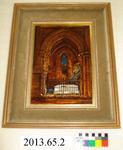
Painting: Church interior by John Calcott St Quentin
Images, Canterbury Museum
One framed painting of a church interior by John Calcott St Quentin, depicting a stone arch above a blue stained glass window. Painted using an old Indian art technique with precious stones on glass. Framed in a green and gold painted wooden frame with a olive green velvet inner, metal slip and gold coloured border. Frame wood and velvet worn wi...
Portable Toilet: Seat, Frame and Bucket
Images, Canterbury Museum
One improvised toilet comprised of a wooden frame with a white plastic toilet seat and lid attached with screws and tape; underneath is a red Lifestyle brand 9.6 litre plastic bucket. Example of the portable toilet designed to be distributed by the Christchurch City Council following the 22 February 2011 earthquake. One common problem experienc...
June 2011 Earthquake - Photograph 02
Images, UC QuakeStudies
Damage to a house in Richmond. Bricks have fallen from the walls, exposing the wooden framing beneath.
WEMO ERT Set 1 - March 2011 - Photograph 09
Images, UC QuakeStudies
A photograph of bricks and wooden framing piled up in between a house and fence in Christchurch.
Photograph by Jocelyn Kinghorn 465
Images, UC QuakeStudies
Damage to the Cranmer Courts. A section of the wall has crumbled, exposing the wooden framing and the interior of the building.
BeckerFraserPhotos June 2011 photograph 057
Images, UC QuakeStudies
A damaged building on Lichfield Street. The brick facade has fallen from the upper storeys, exposing the wooden framing beneath.
Photograph by Jocelyn Kinghorn 466
Images, UC QuakeStudies
Damage to the Cranmer Courts. A section of the wall has crumbled, exposing the wooden framing and the interior of the building.
Painting: Boat scene by John Calcott St Quentin
Images, Canterbury Museum
One framed painting of a boat scene by John Calcott St Quentin, depicting a wooden boat, trees and a low sun. Handwritten note on the back explains technique "Painted using an old Indian art with precious stones on glass". Framed in a brown metal covered frame. Painting may have losses in and above the boat. Who the painting is dedicated to
Photograph by Jocelyn Kinghorn 469
Images, UC QuakeStudies
Detail of damage to the Cranmer Courts. A section of the wall has crumbled, exposing the wooden framing and the interior of the building.
Photograph by Jocelyn Kinghorn 467
Images, UC QuakeStudies
Detail of damage to the Cranmer Courts. A section of the wall has crumbled, exposing the wooden framing and the interior of the building.
Photograph by Jocelyn Kinghorn 468
Images, UC QuakeStudies
Detail of damage to the Cranmer Courts. A section of the wall has crumbled, exposing the wooden framing and the interior of the building.
Diabetes Centre Photograph 055
Images, UC QuakeStudies
A photograph of a room in the Diabetes Centre. The panelling has been taken off the walls, exposing the wooden framing, insulation, and wires.
Diabetes Centre Photograph 051
Images, UC QuakeStudies
A photograph of a kitchen in the Diabetes Centre. The panelling has been removed from the wall of the kitchen, exposing the wooden frame and several pipes and wires.
Diabetes Centre Photograph 054
Images, UC QuakeStudies
A photograph of a kitchen in the Diabetes Centre. The panelling has been removed from the wall of the kitchen, exposing the wooden frame and several pipes and wires.
Diabetes Centre Photograph 107
Images, UC QuakeStudies
A photograph of Knox Church on Bealey Avenue. Much of the brick wall is missing, exposing the wooden framing of the gables and the inside of the church.
Crack'd for Christchurch Photograph 067
Images, UC QuakeStudies
A photograph of Jonathan Hall transferring Crack'd for Christchurch's ottoman artwork onto a wooden base in Helen Campbell's garage. The ottoman has been made out of polystyrene, wood, mesh, and concrete, laid over a steel frame.Crack'd for Christchurch comments, "December 2013. Jonathan delivers the footstool to Helen's garage where it will be mosaicked.."
Diabetes Centre Photograph 059
Images, UC QuakeStudies
A photograph of a room in the Diabetes Centre. The panelling has been removed from the walls, exposing the wooden framing, insulation, and wires underneath. Tarpaulins have been draped over the furniture.
Diabetes Centre Photograph 052
Images, UC QuakeStudies
A photograph of a room in the Diabetes Centre. The panelling has been taken off the walls, exposing the wooden framing, insulation, and wires. There is a step ladder in the corner.
Diabetes Centre Photograph 050
Images, UC QuakeStudies
A photograph of a room in the Diabetes Centre where the furniture has been covered in plastic sheeting. The panelling has been removed from the wall behind, exposing the wooden framing and pink batts.
Gap Golf Photograph 1
Images, UC QuakeStudies
A photograph of the first hole of Gap Filler's Gap Golf course. Written on the wooden framing around the hole is, "Gap golf! Hole 1: Skinny Limits par 2, 6.1 m".
BeckerFraserPhotos February 2011 photograph 322
Images, UC QuakeStudies
Cracks in the concrete foundation and wooden walls of a house on Avonside Drive. The photograph shows where the metal frame of the house's conservatory has come apart, and shards of glass from it can be seen on the footpath.
Diabetes Centre Photograph 058
Images, UC QuakeStudies
A photograph of a room in the Diabetes Centre. The panelling has been removed from the walls, exposing the wooden framing, insulation, and wires underneath. Several drawer units have been stacked in the middle of the room.
Canterbury Earthquake September 2010 - Photograph 13
Images, UC QuakeStudies
Damage to a house in Richmond. Part of the brick wall has slumped to one side, leaving a visible gap between the wall and a windowframe. Broken wooden framing can be seen in the gap. The photographer comments, "Cracking in the external brickwork".
Canterbury Earthquake September 2010 - Photograph 24
Images, UC QuakeStudies
Damage to a house in Richmond. Bricks have fallen from a wall, exposing the wooden framing beneath. The photographer comments, "The foundation and a section of the wall of the dining room have shifted and cracked. The dining room floor is very springy".
Photograph by Jocelyn Kinghorn 442
Images, UC QuakeStudies
A view down Victoria Street from the corner of Victoria Street and Bealey Avenue. On the left is the damaged Knox Church, where the brick has crumbled but the wooden roof frame is still intact. In front is a tent where the Army is guarding the cordon from.
- 1
- »