
Search
found 192 results
Images for [empty query]; more images...
The Christchurch Urban Design Panel: Its role and influence on residential…
Research papers, Lincoln University
During the 21st century, New Zealand has experienced increasing public concern over the quality of the design and appearance of new developments, and their effects on the urban environment. In response to this, a number of local authorities developed a range of tools to address this issue, including urban design panels to review proposals and provide independent advice. Following the 2010 and 2011 Canterbury earthquake sequence, the commitment to achieve high quality urban design within Christchurch was given further importance, with the city facing the unprecedented challenge of rebuilding a ‘vibrant and successful city’. The rebuild and regeneration reinforced the need for independent design review, putting more focus and emphasis on the role and use of the urban design panel; first through collaboratively assisting applicants in achieving a better design outcome for their development by providing an independent set of eyes on their design; and secondly in assisting Council officers in forming their recommendations on resource consent decisions. However, there is a perception that urban design and the role of the urban design panel is not fully understood, with some stakeholders arguing that Council’s urban design requirements are adding cost and complexity to their developments. The purpose of this research was to develop a better understanding on the role of the Christchurch urban design panel post-earthquake in the central city; its direct and indirect influence on the built environment; and the deficiencies in the broader planning framework and institutional settings that it might be addressing. Ultimately, the perceived role of the Panel is understood, and there is agreement that urban design is having a positive influence on the built environment, albeit viewed differently amongst the varying groups involved. What has become clear throughout this research is that the perceived tension between the development community and urban design well and truly exists, with the urban design panel contributing towards this. This tension is exacerbated further through the cost of urban design to developers, and the drive for financial return from their investments. The panel, albeit promoting a positive experience, is simply a ‘tick box’ exercise for some, and as the research suggests, groups or professional are determining themselves what constitutes good urban design, based on their attitude, the context in which they sit and the financial constraints to incorporate good design elements. It is perhaps a bleak time for urban design, and more about building homes.
Between the cracks: The intersection of individuals, social processes and …
Research papers, Lincoln University
This research investigates creativity in a post-disaster setting. The data explore creativity at the intersection of the affected community of Christchurch, New Zealand and the social processes that followed the earthquakes of 2010 - 2012. Personal and contextual influences on creative ideas implemented for community or commercial benefit are also examined. Viewed as creative, unique approaches to post-disaster problem solving were celebrated locally, nationally and internationally (Bergman, 2014; Wesener, 2015; Cloke & Conradson, 2018). Much has been written about creativity, particularly creativity in organisations and in business. However, little is known with regards to who creates after a disaster, why individuals choose to do so and what impact the post-disaster context has on their creative activity. This exploratory study draws on the literature from the fields of creativity, disasters, psychology, sociology and entrepreneurship to interpret first-hand accounts of people who acted on creative ideas in a physically and socially altered environment. A mixed method - albeit predominantly qualitative - approach to data gathering was adopted that included interviews (n=45) with participants who had been the primary drivers of creative ideas implemented in Christchurch after September 2010 – the first major (7.1 magnitude) earthquake in a prolonged sequence of thousands of aftershocks. Key findings include that a specific type of creativity results from the ‘collision’ between individuals and social processes activated by a disaster situation. This type of creativity could be best categorised as ‘little c’ or socially adaptive and emerges through a prosocial filter. There is wide consensus amongst creativity researchers - principally social psychologists - that for output to be considered creative it must be both novel and useful (Runco & Jaegar, 2012). There is greater tolerance for the novelty component after a disaster as novelty itself has greater utility, either as a distraction or because alternatives are few. Existing creativity models show context as input – an additional component of the creative process – but after a disaster the event itself becomes the catalyst for social processes that result in the creativity seen. Most participants demonstrated characteristics commonly associated with creativity and could be categorised as either a ‘free thinker’ and/or an ‘opportunist’. Some appear preadapted to create and thrive in unstable circumstances. Findings from participants’ completion of a Ten Item Personality Inventory (TIPI) showed an apparent reduced need for extraversion in relation to implementing creative ventures in society. This factor, along with higher levels of agreeableness may indicate a potentially detrimental effect on the success of creative ideas established after a disaster, despite earnest intentions. Three new models are presented to illustrate the key findings of this study. The models imply that disasters enhance both the perceived value of creativity and the desire to act creatively for prosocial ends. The models also indicate that these disaster influenced changes are likely to be temporary.
Digital Photograph: Cathedral of the Blessed Sacrament exterior angels sal…
Images, Canterbury Museum
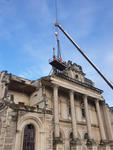
One digital photograph showing a crane arm and workers in a cage during the salvage of the exterior angels from atop the Cathedral of the Blessed Sacrament. The large intact columns at the entrance of the Cathedral can be seen in the photograph. Taken by the Catholic Diocese of Christchurch in September 2020.
Digital Photograph: Cathedral of the Blessed Sacrament being demolished
Images, Canterbury Museum
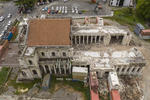
One digital photograph taken by drone showing the Cathedral of the Blessed Sacrament partially demolished. Taken by the Catholic Diocese of Christchurch in 2020.
Digital Photograph: Cathedral of the Blessed Sacrament partially demolished
Images, Canterbury Museum
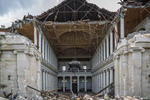
One digital photograph showing the Cathedral of the Blessed Sacrament partially demolished. The interior is visible and lined with intact columns. Taken by photographer Helen McLeod in October 2020.
Digital Photograph: Cathedral of the Blessed Sacrament being demolished by…
Images, Canterbury Museum
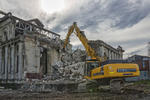
One digital photograph showing the Cathedral of the Blessed Sacrament being demolished with a yellow digger. Taken by photographer Helen McLeod in September 2020.
Digital Photograph: Cathedral of the Blessed Sacrament interior during dem…
Images, Canterbury Museum
One digital photograph showing the Cathedral of the Blessed Sacrament interior during demolition. The nave columns are still intact but debris lines the floor. Taken by photographer Helen McLeod in November 2020.
Digital Photograph: Cathedral of the Blessed Sacrament during demolition b…
Images, Canterbury Museum
One digital photograph showing the Cathedral of the Blessed Sacrament during demolition. A yellow digger arm and nibbler claw can be seen along with stone falling from an exterior wall. Taken by photographer Helen McLeod in December 2020.
Digital Photograph: Cathedral of the Blessed Sacrament exterior angels
Images, Canterbury Museum
One digital photograph showing the two angels atop the Cathedral of the Blessed Sacrament. The plinth that supports the cross stands empty between the angels. Taken by the Catholic Diocese of Christchurch in August 2020 before the angels were salvaged from the building.
Digital Photograph: Cathedral of the Blessed Sacrament exterior angels sal…
Images, Canterbury Museum
One digital photograph showing a crane and workers in a cage during the salvage of the exterior angels from atop the Cathedral of the Blessed Sacrament. Taken by the Catholic Diocese of Christchurch in August 2020.
Digital Photograph: Cathedral of the Blessed Sacrament exterior angels sal…
Images, Canterbury Museum
One digital photograph showing the salvage of the exterior angels from the Cathedral of the Blessed Sacrament. Two crane arms and strapping around one of the angels can be seen in the photograph. Taken by the Catholic Diocese of Christchurch in September 2020.
Digital Photograph: Cathedral of the Blessed Sacrament demolition
Images, Canterbury Museum
One digital photograph showing the demolition of the Cathedral of the Blessed Sacrament. A digger arm and nibbler claw can be seen in the photograph removing stone from the exterior, intact columns and ionic column capitals can be seen inside. Taken by the Catholic Diocese of Christchurch in September 2020.
FRONTLINE: The nexus of political documentary and alternative journalism:
Research papers, The University of Auckland Library
<jats:p>This article is a critical commentary of how political documentary embodies the traits and functions of alternative journalism. I explore this notion through Obrero (‘worker’) my independent documentary project about the labour migration of Filipino workers to Christchurch, Aotearoa New Zealand, after the earthquake in 2011. This article maps out the points at where the theories and practices of alternative media and documentary intersect. Analysing political documentary as a format of alternative journalism has links to the long tradition of film and video production as a tool for social critique. As a form of practice-based research, Obrero falls under the rubric of alternative journalism—able to represent the politically marginal sectors of the polity and report on issues underreported in the mainstream press. This article concludes that a distribution plan that is responsive to fragmenting audiences works best when alternative journalism no longer targets a niche but transborder audiences.</jats:p>
Strategies for earthquake strengthening vintage clay-brick unreinforced ma…
Research papers, The University of Auckland Library
This thesis describes the strategies for earthquake strengthening vintage clay bricks unreinforced masonry (URM) buildings. URM buildings are well known to be vulnerable to damage from earthquake-induced lateral forces that may result in partial or full building collapse. The 2010/2011 Canterbury earthquakes are the most recent destructive natural disaster that resulted in the deaths of 185 people. The earthquake events had drawn people’s attention when URM failure and collapse caused about 39 of the fatality. Despite the poor performance of URM buildings during the 2010/2011 Canterbury earthquakes, a number of successful case study buildings were identified and their details research in-depth. In order to discover the successful seismic retrofitting techniques, two case studies of retrofitted historical buildings located in Christchurch, New Zealand i.e. Orion’s URM substations and an iconic Heritage Hotel (aka Old Government Building) was conducted by investigating and evaluating the earthquake performance of the seismic retrofitting technique applied on the buildings prior to the 2010/2011 Canterbury earthquakes and their performance after the earthquakes sequence. The second part of the research reported in this thesis was directed with the primary aim of developing a cost-effective seismic retrofitting technique with minimal interference to the vintage clay-bricks URM buildings. Two retrofitting techniques, (i) near-surface mounted steel wire rope (NSM-SWR) with further investigation on URM wallettes to get deeper understanding the URM in-plane behaviour, and (ii) FRP anchor are reported in this research thesis
Seismic response of adjacent structures on dry and saturated sand
Research papers, The University of Auckland Library
Soil-structure interaction (SSI) has been widely studied during the last decades. The influence of the properties of the ground motion, the structure and the soil have been addressed. However, most of the studies in this field consider a stand-alone structure. This assumption is rarely justifiable in dense urban areas where structures are built close to one another. The dynamic interaction between adjacent structures has been studied since the early 1970s, mainly using numerical and analytical models. Even though the early works in this field have significantly contributed to understanding this problem, they commonly consider important simplifications such as assuming a linear behaviour of the structure and the soil. Some experimental works addressing adjacent structures have recently been conducted using geotechnical centrifuges and 1g shake tables. However, further research is needed to enhance the understanding of this complex phenomenon. A particular case of SSI is that of structures founded in fine loose saturated sandy soil. An iconic example was the devastating effects of liquefaction in Christchurch, New Zealand, during the Canterbury earthquake in 2011. In the case of adjacent structures on liquefiable soil, the experimental evidence is even scarcer. The present work addresses the dynamic interaction between adjacent structures by performing multiple experimental studies. The work starts with two-adjacent structures on a small soil container to expose the basics of the problem. Later, results from tests considering a more significant number of structures on a big laminar box filled with sand are presented. Finally, the response of adjacent structures on saturated sandy soil is addressed using a geotechnical centrifuge and a large 1g shake table. This research shows that the acceleration, lateral displacement, foundation rocking, damping ratio, and fundamental frequency of the structure of focus are considerably affected by the presence of neighbouring buildings. In general, adjacent buildings reduced the dynamic response of the structure of focus on dry sand. However, the acceleration was amplified when the structures had a similar fundamental frequency. In the case of structures on saturated sand, the presence of adjacent structures reduced the liquefaction potential. Neighbouring structures on saturated sand also presented larger rotation of the footing and lateral displacement of the top mass than that of the stand-alone case
Obrero (“worker”): Practising and theorising political documentary across …
Research papers, The University of Auckland Library
This thesis is a creative and critical exploration of how transmedia storytelling meshes with political documentary’s nature of representing social realities and goals to educate and promote social change. I explore this notion through Obrero (“worker”), my independently produced transmedia and transjournalistic documentary project that explores the conditions and context of the Filipino rebuild workers who migrated to Christchurch, New Zealand after the earthquake in 2011. While the project should appeal to New Zealanders, it is specifically targeted at an audience from the Philippines. Obrero began as a film festival documentary that co-exists with strategically refashioned Web 2.0 variants, a social network documentary and an interactive documentary (i-doc). Using data derived from the production and circulation of Obrero, I interrogate how the documentary’s variants engage with differing audiences and assess the extent to which this engagement might be effective. This thesis argues that contemporary documentary needs to re-negotiate established film aesthetics and practices to adapt in the current period of shifting technologies and fragmented audiences. Documentary’s migration to new media platforms also creates a demand for filmmakers to work with a transmedia state of mind—that is, the capacity to practise the old canons of documentary making while comfortably adjusting to new media production praxis, ethics, and aesthetics. Then Obrero itself, as the creative component of this thesis, becomes an instance of research through creative practice. It does so in two respects: adding new knowledge about the context, politics, and experiences of the Filipino workers in New Zealand; and offering up a broader model for documentary engagement, which I analyse for its efficacy in the digital age
Residents fed up with red zone rubbish
Audio, Radio New Zealand
Christchurch red zone residents say the area is experiencing an increasing amount of petty crime and dumped rubbish, due to a lack of people. The red zone was established after thousands of houses - and the land underneath them - suffered severe damage in the 2010 and 2011 earthquakes. Last year (2019), a Regeneration Plan for the area was signed off by the government - which included building walkways, cycleways, forests, wetlands, and sport and recreation areas. That's all designed to get people back into the red zone area - but much of the work is still years away. Logan Church met a resident who told him that in the meantime, things are deteriorating.
Catharsis as Christchurch quake redzone development opens
Audio, Radio New Zealand
Christchurch residents forced away from their redzone homes returned today for the unveiling of the the Avon loop pathway - the first redevelopment, nine years on from the deadly earthquake. Reporter Conan Young went along to hear from them.
Covid-19 lockdown: Christchurch readies for more tough times
Audio, Radio New Zealand
As the nation prepares for lockdown, Christchurch's leaders says their city is prepared. Over the past ten years Christchurch has dealt with it's fair share of crisis, from earthquakes, Port Hills fires, the March 15 terror attacks, flooding, and a gas explosion. While Covid-19 has a global impact, some Cantabrians say their past experience will help them get through. Eleisha Foon reports.
EQC's legacy a degraded housing stock, inquiry finds
Audio, Radio New Zealand
The chair of the inquiry in to the Earthquake Commission has grave concerns about the state of the housing stock in Christchurch due to EQC's failure to properly fix quake damage. It's just one of a raft of findings released by Dame Silvia Cartwright today, after a year and a half long inquiry that heard from hundreds of homeowners and key players. Conan Young has the story.
EQC found by inquiry to be poorly prepared for quakes
Audio, Radio New Zealand
An inquiry into the Earthquake Commission has found it was poorly prepared for the Canterbury earthquakes - and has left people with a "deep mistrust of government" that will take years to overcome. The government has this morning released findings from the inquiry, chaired by Dame Silvia Cartwright. Our Christchurch reporter, Conan Young, has been reading through the details and spoke with Māni Dunlop.
EQC ill-prepared to handle Canterbury repairs - Dame Silvia Cartwright
Audio, Radio New Zealand
EQC was ill-prepared to deal with the wide spread damage of the Christchurch Earthquakes and as a consequence its reputation been left in tatters with many seeing the commission as uncaring, miserly and inefficient. That is according to the findings of the inquiry into EQC and its handling of quake claims in Canterbury and Kaikōura. Inquiry Chair Dame Silvia Cartwright lays out a raft of inadequacies including EQC not being equiped to handle a mass scale managed repair programme - leading to multiple mistakes, poor staffing decisions and inadequate quality control. Damage assessments were the root of claimants disputes time and time again. Dame Silvia Cartwright described to Checkpoint the way claimants have been treated by EQC.
Midday News for 9 April 2020
Audio, Radio New Zealand
An report into EQC finds it was poorly prepared for the Canterbury earthquakes. Quarantined travelers have moved before 14 days. Anna Thomas has the news.
Coronavirus: Business owner caught by small print in lease
Audio, Radio New Zealand
A Taranaki business owner is warning leaseholders to read the fine print of their contracts after being asked to pay his rent in full despite a clause in his lease allowing for a rent cut if he couldn't legally access the property. Clause 27.5 was included in the Auckland District Law Society commercial lease in 2012 in response to the Canterbury earthquakes, when many leaseholders were barred from their businesses. RNZ reporter Robin Martin has more.
Coronavirus: Schools warned to be careful of mental health on reopening
Audio, Radio New Zealand
Education advisors are warning that children could suffer mental health problems for years to come if schools botch their return to the classroom. They say the Christchurch earthquakes and Australian bushfires show teachers should resist the temptation to launch straight back into normal lessons after a major event. Principals are hoping to learn today when they will move into alert level two and how many of their students will be able to return to school. RNZ's education correspondent John Gerritsen reports.
EQC level 2 rules causing more delays, stress - Christchurch couple
Audio, Radio New Zealand
An elderly Christchurch couple are crying foul over EQC's site visit policy under alert level two. EQC says the measures, outlined in emails to clients, are crucial for staff and customer safety. But John and Frances van Petegem, who have been waiting years to have botched earthquake repairs put right, say EQC's rules are causing further delays and stress. Nick Truebridge has the story.
Southern Response in court contesting class action
Audio, Radio New Zealand
Southern Response is back in court today - this time having a final go at arguing that a class action against it should not be an 'opt-out'. Christchurch residents Brendan and Colleen Ross say the state insurer deliberately withheld the true cost of repairing their home which was damaged in the Canterbury earthquakes. They are now among 3000 people represented in a class action led by Christchurch lawyer Grant Cameron. In September last year the Court of Appeal decided the class action could proceed on an 'opt-out' basis - which means it would cover more people and potentially cost the state-owned insurer more money if it loses. Southern Response is challenging that decision in the Supreme Court, a two day hearing wrapped up on Tuesday. Checkpoint reporter Logan Church was there.
Redcliffs school moves to new site nine years after quakes
Audio, Radio New Zealand
A Christchurch primary school is moving into its permanent new home today, nine years after cliffs behind it collapsed during the city's earthquakes. Redcliffs School subsequently moved to a temporary location in the suburb of Sumner, but the new location will mean the school will return home to Redcliffs, after a land swap with the local park. The move comes after in 2016, the then National Government, overturned its own decision to close the school. Christchurch reporter Anan Zaki spoke to principal Rose McInerney ahead of today's move.
Redcliffs School reopens after years of perseverance since Canterbury quak…
Audio, Radio New Zealand
It's been dubbed Canterbury's little seaside community who never gave up. Nine years in the making, it was Redcliffs School''s grand re-opening today after earthquake damage rendered the old site unsafe. The occasion was marked with tears, hugging, singing and some very special guests. Katie Todd filed this report.
Managed isolation hotels too posh for returnee
Audio, Radio New Zealand
Our managed isolation hotels are too posh and returnees should not be treated like hotel guests with luxuries like free menu choices and drycleaning. That's the verdict from New Zealand woman Toni Foster who has returned to the country to take up a job and has spent the past 11 days in isolation at Ellerslie's Novotel Hotel. Toni says she had expected to return to isolation in accommodation similar to the container village after the Christchurch earthquakes - not a free four or five star hotel which she said some returnees were treating as a holiday. She says returnees should not be treated like hotel guests because they're not paying a cent to be there.