

Search
found 201 results
Images for [empty query]; more images...
Supreme court has ruled in favour of earthquake hit home owners
Audio, Radio New Zealand
The Supreme Court has ruled that a class action by Canterbury insurance holders against Southern Response can go ahead. Ali Jones, insurance claimants advocate explains to The Panel what this means for home owners who've been fighting for years to get their fair entitlements.
A tour of Christchurch Architecture - old and new
Audio, Radio New Zealand
Christchurch’s architecture, both new and old, has been brought to life in an illustrated walking book that pays homage to the city’s historical buildings and showcases its new direction in the post-earthquake era.
CH Earthquake:CTV victims' families continue push for justice
Audio, Radio New Zealand
The families of those who died in the CTV building's collapse during the Christchurch Earthquake in February of 2011 are vowing to continue their Fight For Justice after The Independent Police Conduct Authority rejected their complaint about the Police Investigation . The Police decided 3 years ago not to lay charges against the building's designer. Yesterday the families announced that the IPCA, the body that advised the Police, had told them that it had no jurisdiction over Crown Law. Families spokesperson, Maan Alkaisi, told reporter Conan Young that they will continue to push for somebody to be held to account. He wants a retired judge to take another look at the decision not to prosecute.
Government sets up package for Southern Response claimants
Audio, Radio New Zealand
A lawyer acting for Christchurch home-owners short changed in earthquake settlements says a new plan announced by the government is likely to run into trouble. Last year in a landmark case, the High Court found the government's claim settlement agency, Southern Response, misled and deceived Karl and Alison Dodds. It ordered the government to pay the couple nearly $180,000. The government has now set up a package for other Southern Response claimants who settled before October 2014. Its estimated about 3000 people will be eligible to benefit. But most of them are already taking part in a class action led by Brendan and Colleen Ross. Their lawyer Grant Cameron speaks to Corin Dann.
Christ Church Cathedral's day of restoration
Audio, Radio New Zealand
A momentous day in Christchurch as a huge steel frame was installed as part of the stabilisation work for Christ Church Cathedral. Karyn speaks with project director Keith Paterson about the plans to return the famed rose window extensively damage in the 2011 earthquake.
Christ Church Cathedral restoration: Massive steel frame being installed t…
Audio, Radio New Zealand
Moves towards returning the famed rose window to Christ Church Cathedral begin today. An eighteen-tonne steel frame is being installed onto the cathedral's west facade as part of restoration work. It will eventually housing the rose window. The cathedral was critically damaged in the Christchurch earthquake of 2011. Project director Keith Paterson is in Cathedral Square. He speaks to Susie Ferguson.
RECOVER Issue 5
Research papers, University of Canterbury Library
Welcome to the Recover newsletter Issue 5 from the Marine Ecology Research Group (MERG) of the University of Canterbury. Recover is designed to keep you updated on our MBIE-funded earthquake recovery project called RECOVER (Reef Ecology, Coastal Values & Earthquake Recovery). This 5th instalment covers the question of how much of the coast uplifted how much, recent lab work on seaweed responses to stressors, and more on our drone survey work to quantify earthquake impacts and recovery along 130 km of coastline in the intertidal zone!
Exploring the social capital of temporary Filipino migrant workers in Cant…
Research papers, University of Canterbury Library
Rising disaster losses, growth in global migration, migrant labour trends, and increasingly diverse populations have serious implications for disaster resilience around the world. These issues are of particular concern in New Zealand, which is highly exposed to disaster risk and has the highest proportion of migrant workers to national population in the OECD. Since there has been no research conducted into this issue in New Zealand to date, greater understanding of the social capital used by migrant workers in specific New Zealand contexts is needed to inform more targeted and inclusive disaster risk management approaches. A New Zealand case study is used to investigate the extent and types of social capital and levels of disaster risk awareness reported by members of three Filipino migrant workers organisations catering to dairy farm, construction and aged care workers in different urban and rural Canterbury districts. Findings from (3) semi-structured interviews and (3) focus groups include consistently high reliance on bonding capital and low levels of bridging capital across all three organisations and industry sectors, and in both urban and rural contexts. The transitory, precarious residential status conveyed by temporary work visas, and the difficulty of building bridging capital with host communities has contributed to this heavy reliance on bonding capital. Social media was essential to connect workers with family and friends in other countries, while Filipino migrant workers organisations provided members with valuable access to industry and district-specific networks of other Filipino migrant workers. Linking capital varied between the three organisations, with members of the organisation set up to advocate for dairy farm workers reporting the highest levels of linking capital. Factors influencing the capacity of workers organisations to develop linking capital appeared to include motivation (establishment objectives), length of time since establishment, support from government and industry groups, urban-rural context, income levels and gender. Although aware of publicity around earthquake and tsunami risk in the Canterbury region, participants were less aware of flood risk, and expressed fatalistic attitudes to disaster risk. Workers organisations offer a valuable potential interface between CDEM Group activities and migrant worker communities, since organisation leaders were interested in accessing government support to participate (with and on behalf of members) in disaster risk planning at district and regional level. With the potential to increase disaster resilience among these vulnerable, hard to reach communities, such participation could also help to build capacity across workers organisations (within Canterbury and across the country) to develop linking capital at national, as well as regional level. However, these links will also depend on greater government and industry commitment to providing more targeted and appropriate support for migrant workers, including consideration of the cultural qualifications of staff tasked with liaising with this community.
A neutal network for ground motion quality classification from New Zealand…
Research papers, University of Canterbury Library
High-quality ground motion records are required for engineering applications including response history analysis, seismic hazard development, and validation of physics-based ground motion simulations. However, the determination of whether a ground motion record is high-quality is poorly handled by automation with mathematical functions and can become prohibitive if done manually. Machine learning applications are well-suited to this problem, and a previous feed-forward neural network was developed (Bellagamba et al. 2019) to determine high-quality records from small crustal events in the Canterbury and Wellington regions for simulation validation. This prior work was however limited by the omission of moderate-to-large magnitude events and those from other tectonic environments, as well as a lack of explicit determination of the minimum usable frequency of the ground motion. To address these shortcomings, an updated neural network was developed to predict the quality of ground motion records for all magnitudes and all tectonic sources—active shallow crustal, subduction intraslab, and subduction interface—in New Zealand. The predictive performance of the previous feed-forward neural network was matched by the neural network in the domain of small crustal records, and this level of predictive performance is now extended to all source magnitudes and types in New Zealand making the neural network applicable to global ground motion databases. Furthermore, the neural network provides quality and minimum usable frequency predictions for each of the three orthogonal components of a record which may then be mapped into a binary quality decision or otherwise applied as desired. This framework provides flexibility for the end user to predict high-quality records with various acceptability thresholds allowing for this neural network to be used in a range of applications.
Disaster recovery of small and medium enterprises (SMEs) – a case of recov…
Research papers, University of Canterbury Library
The initial goal of this research was to explore how SME business models change in response to a crisis. Keeping this in mind, the business model canvas (Osterwalder & Pigneur, 2010) was used as a tool to analyse SME business models in the Canterbury region of New Zealand. The purpose was to evaluate the changes SMEs instituted in their business models after being hit by a series of earthquakes in 2010 and 2011. The idea was to conduct interviews with business owners and analyse them using grounded theory methods. As this method is iterative and requires simultaneous data collection and analysis, a tentative model was proposed after first phase of the data collection and analysis. However, as a result of this process, it became apparent that owner-specific characteristics, action orientation and networks were more prominent in the data than business model elements. Although the SMEs in this study experienced several operational changes in their business models, such as a change of location, modifications to their payment terms or expanded/restricted target markets, the suggested framework highlights how owner-specific attributes ensured the recovery of their businesses. After the initial framework was suggested, subsequent interviews were conducted to test, verify, and modify the tentative model. Three aspects of business recovery emerged: (a) cognitive coping – the business owner’s mind-set and motive; (b) adaptive coping – the ability of business owner to take corrective actions; and (c) social capital – the social network of a business owner, including formal and informal connections and their significance. Three distinct groups were identified; self-sufficient SMEs, socially-based SMEs and surviving SMEs. This thesis proposes a grounded theory of business recovery for SMEs following a disaster. Cognitive coping and social capital enabled the owners to take actions, which eventually led to the desired outcomes for the businesses.
The Rebuild 326-366
Images, eqnz.chch.2010
This is St Peters Riccarton. It was damaged in one of the two big Earthquakes to hit Christchurch in September 2010 and February 2011. Its taken a LONG time for work to really get going, but now that it is, they are also upgrading and extending the church with a modern annexe.
Digital Photograph: Cathedral of the Blessed Sacrament exterior angels sal…
Images, Canterbury Museum
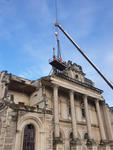
One digital photograph showing a crane arm and workers in a cage during the salvage of the exterior angels from atop the Cathedral of the Blessed Sacrament. The large intact columns at the entrance of the Cathedral can be seen in the photograph. Taken by the Catholic Diocese of Christchurch in September 2020.
Digital Photograph: Cathedral of the Blessed Sacrament being demolished
Images, Canterbury Museum
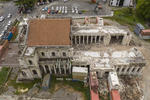
One digital photograph taken by drone showing the Cathedral of the Blessed Sacrament partially demolished. Taken by the Catholic Diocese of Christchurch in 2020.
Digital Photograph: Cathedral of the Blessed Sacrament partially demolished
Images, Canterbury Museum
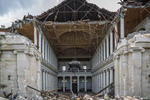
One digital photograph showing the Cathedral of the Blessed Sacrament partially demolished. The interior is visible and lined with intact columns. Taken by photographer Helen McLeod in October 2020.
Digital Photograph: Cathedral of the Blessed Sacrament being demolished by…
Images, Canterbury Museum
One digital photograph showing the Cathedral of the Blessed Sacrament being demolished with a yellow digger. Taken by photographer Helen McLeod in September 2020.
Digital Photograph: Cathedral of the Blessed Sacrament interior during dem…
Images, Canterbury Museum
One digital photograph showing the Cathedral of the Blessed Sacrament interior during demolition. The nave columns are still intact but debris lines the floor. Taken by photographer Helen McLeod in November 2020.
Digital Photograph: Cathedral of the Blessed Sacrament during demolition b…
Images, Canterbury Museum
One digital photograph showing the Cathedral of the Blessed Sacrament during demolition. A yellow digger arm and nibbler claw can be seen along with stone falling from an exterior wall. Taken by photographer Helen McLeod in December 2020.
Digital Photograph: Cathedral of the Blessed Sacrament exterior angels
Images, Canterbury Museum
One digital photograph showing the two angels atop the Cathedral of the Blessed Sacrament. The plinth that supports the cross stands empty between the angels. Taken by the Catholic Diocese of Christchurch in August 2020 before the angels were salvaged from the building.
Digital Photograph: Cathedral of the Blessed Sacrament exterior angels sal…
Images, Canterbury Museum
One digital photograph showing a crane and workers in a cage during the salvage of the exterior angels from atop the Cathedral of the Blessed Sacrament. Taken by the Catholic Diocese of Christchurch in August 2020.
Digital Photograph: Cathedral of the Blessed Sacrament exterior angels sal…
Images, Canterbury Museum
One digital photograph showing the salvage of the exterior angels from the Cathedral of the Blessed Sacrament. Two crane arms and strapping around one of the angels can be seen in the photograph. Taken by the Catholic Diocese of Christchurch in September 2020.
Digital Photograph: Cathedral of the Blessed Sacrament demolition
Images, Canterbury Museum
One digital photograph showing the demolition of the Cathedral of the Blessed Sacrament. A digger arm and nibbler claw can be seen in the photograph removing stone from the exterior, intact columns and ionic column capitals can be seen inside. Taken by the Catholic Diocese of Christchurch in September 2020.