

Search
found 12246 results

Cranmer Court
Images, eqnz.chch.2010
The Cranmer Court demolition started today in Christchurch. The 1876 building was originally a Normal School and was in a derelict state in the early 1980s when it was rescued and converted into apartments. The heritage-listed building was red-stickered after the February 2011 earthquake.

Christchurch Cathedral Square Cathedral
Images, eqnz.chch.2010
The Christchurch Cathedral after loosing its tower and spire after the 6.3 quake hit Christchurch 22 February 2011. The February 22 quake cracked pillars, twisted walls, shattered stained glass, collapsed buttresses, fractured masonry and toppled the tower. The rose window in the west wall collapsed in the June aftershocks. Demolition of the Chr...

20121117_0338_1D3-150 The old Police Station
Images, eqnz.chch.2010
Cordoned off after damage from the earthquakes.

Christchurch Earthquake Civic Memorial
Images, eqnz.chch.2010
North Hagley Park, Christchurch, New Zealand. Tens of thousands turned out today to mark the one year anniversary of the devastating earthquake that struck the city at 12.51pm on 22 February, 2011. 185 people lost their lives. file.stuff.co.nz/stuff/12-51/ Took 4 pa...

Christchurch Cathedral - Stay of Execution
Images, eqnz.chch.2010
Christ Church Cathedral has been granted a stay of execution after a High-Court ruling today to stop the planned demolition of the earthquake-damaged Christchurch central landmark.

Christchurch Earthquake - Godley House, Diamond Harbour
Images, eqnz.chch.2010
Due to the 7.1 earthquake on 4th September 2010 and then the following earthquakes Godley House has suffered severe damage. Godley house was built in 1880 by Harvey Hawkins - see www.godleyhouse.co.nz/
Rosalee Jenkin Photograph 28
Images, UC QuakeStudies
A photograph of the former site of Westende Jewellers and Alva Rados, on the corner of Manchester Street and Worcester Street. The building was badly-damaged in the 4 September earthquake and was demolished soon afterwards. A two-storey building was built on the site and completed in July 2012. The building then had to be removed when the decision was made to widen Manchester Street as part of the draft transport plan for central Christchurch. The photograph was modelled after an image taken by Ian McGregor from Fairfax Media in September 2010.
Rosalee Jenkin Photograph 27
Images, UC QuakeStudies
A photograph of the former site of Westende Jewellers and Alva Rados, on the corner of Manchester Street and Worcester Street. The building was badly-damaged in the 4 September earthquake and was demolished soon afterwards. A two-storey building was built on the site and completed in July 2012. The building then had to be removed when the decision was made to widen Manchester Street as part of the draft transport plan for central Christchurch. The photograph was modelled after an image taken by Ian McGregor from Fairfax Media in September 2010.
Elizabeth Ackermann Photograph 336
Images, UC QuakeStudies
A photograph of the north side of the ChristChurch Cathedral in Cathedral Square. The front of the building has been propped up with steel bracing but further earthquakes have caused more damage, leaving a gap between the bracing and the wall. The tower has been partially demolished, but the lower section is still visible. Wire fencing has been placed around the entire building. In the background, a crane is rising high above the square.
Elizabeth Ackermann Photograph 337
Images, UC QuakeStudies
A photograph of the north side of the ChristChurch Cathedral in Cathedral Square. The front of the building has been propped up with steel bracing but further earthquakes have caused more damage, leaving a gap between the bracing and the wall. The tower has been partially demolished, but the lower section is still visible. Wire fencing has been placed around the entire building. In the background, a crane is rising high above the square.
The Face of a Quake
Images, UC QuakeStudies
A damaged brick building on Tuam Street. Bricks have fallen from the wall exposing the interior, where a wooden structure can be seen to have collapsed. The photographer comments, "This is the damage caused by the numerous earthquakes in Christchurch, New Zealand. It closely resembles a face and the round blob in the square hole at the top of the nose is a pigeon".
A Modern Day Miracle
Images, UC QuakeStudies
A digitally manipulated image of a statue of the Virgin Mary in a broken window of the Cathedral of the Blessed Sacrament. The photographer comments, "Before the February 2011 earthquake the statue above was facing into the Cathedral looking down a corridor, but after it had turned 180 degrees to point towards the window. The statue of Mary turning like this gave a sign of hope for the people of Christchurch. It was amongst one of the most photographed things after the earthquake until it was removed".
The Nervous Pigeon
Images, UC QuakeStudies
A pigeon perches in the beams of a damaged building. The photographer comments, "The building next door was demolished after the Christchurch earthquake, which exposed the side of this building with it's very old corrugated iron walls. Some of the sheeting was damaged and exposed parts of the interior. The pigeon was sitting on a bit of wood with the beam above it had a very serious crack. I think you would be nervous as well".
The State of Christchurch Heritage
Images, UC QuakeStudies
A digitally manipulated image of a broken window. The photographer comments, "There is hardly anything left of Christchurch's proud heritage buildings. Most older buildings were made of brick and though they should have had improvements to make them withstand a medium earthquake most did not. They were badly damaged when hit with a series of earthquakes that were up to 2.2g at the epicentre and 1.88g in the City".
The Samples
Images, UC QuakeStudies
A box containing drilling cores from soil sampling. The photographer comments, "These are the samples from drilling near my home. As you can see they are not so much samples as sand piles. The drill in a nearby street went down 20m and it was sand all the way. This is the box of samples from the ground level to 4.6m deep".
Shown the Red Card
Images, UC QuakeStudies
A man reads a sign posted on the door of the Christchurch Art Gallery, which reads "The gallery is currently closed to the public". The photographer comments, "Red Carded - A red-coloured card shown by a referee to a player, especially in soccer, to indicate that the player is being ejected from the pitch. The Christchurch Art Gallery has left the building. All the current and future exhibitions of the Art Gallery are being mainly held out of doors".
Elizabeth Ackermann Photograph 347
Images, UC QuakeStudies
A photograph of the north side of the ChristChurch Cathedral in Cathedral Square. The front of the building has been propped up with steel bracing but further earthquakes have caused more damage, leaving a gap between the bracing and the wall. The tower has been partially demolished, but the lower section is still visible. Wire fencing has been placed around the entire building. In the background, a crane is rising high above the square.
Romeo, Get Off That Balcony!
Images, UC QuakeStudies
A two-storey house in Avonside Drive with a warped upper balcony. The photographer comments, "This house is on Avonside Drive opposite the Avon River. The land in this area spread laterally and had bad liquefaction of the soil. This caused some houses to sink into the ground, but as the balcony supports did not sink as much the balcony came to rest at a crazy angle".
You Know the Drill
Images, UC QuakeStudies
Workers operate a drilling rig, sampling soil as part of EQC's geotechnical investigation of TC3 land. The photographer comments, "The work of getting 'soil' samples from all the areas marked as green/blue zones in Christchurch. These areas may be susceptible to liquefaction if a major earthquake occurs. The soil samples were a failure as all they found was sand".
It Must Have Anglo-Saxon Heritage
Images, UC QuakeStudies
A building on St Asaph Street has been demolished, exposing the interior structure of the adjoining building. The photographer comments, "The building that this one was part of has been demolished and the join looks very much like the exterior walls of an Anglo-Saxon house. It has been exposed due to the demolition of damaged buildings after the Christchurch earthquake".
Sagging in the Middle
Images, UC QuakeStudies
A wooden house in Wainoni has visibly bowed inwards towards its centre. The photographer comments, "During the numerous earthquakes in Christchurch the land which ran alongside the Avon river on Avonside Drive slumped towards the waterway. In a line parallel to the road the road, but around 20m away a ground movement occurred which caused some houses to rise up or sink down".

20121117_2387_G12-06 New Brighton Road flooded again
Images, eqnz.chch.2010
With the land dropping about 1metre to 1.4metres after the earthquakes, a few roads besides the Avon and Heathcote Rivers are flooded with very high tides. Extra stop banks (on right) erected after the quakes have helped, but the road is now well below high water level. New Brighton Road, just short of New Brighton. The Pages Road bridge may b...
The View Through the Blue
Images, UC QuakeStudies
Workers seen through a gap between wooden pallets in GapFiller's Pallet Pavillion. The photographer comments, "Though it looks strange and Photoshopped this is a straight shot through pallets painted blue. The Pallet Pavilion is built on the site of the demolished Crowne Plaza Hotel. It was built by volunteers, mainly students and construction engineers over 6 weeks. Here students are being given health and safety instructions before helping out on completing the temporary structure".
The Earthquake Worms
Images, UC QuakeStudies
A digitally manipulated photograph of twisted reinforcing rods amongst the rubble from the demolition of QEII. The photographer comments, "These rarely seen worms live in the pressurised earth under the foundations of buildings. They need a damp soil and be under at least 100 pounds of pressure per square inch. After the destructive force of an earthquake they swiftly rise to the surface through gaps in the rubble. Unfortunately they quickly die and then crystallise as hard as iron in the dry low pressure air".
Sam Butcher's LEGO Cathedral, Photograph 52
Images, UC QuakeStudies
A photograph of components of a model of the ChristChurch Cathedral being built from LEGO by Sam Butcher. Sam comments "Fixing a large variety of bits that were wrong/annoying/cheating (not purist) about the last model. The new one is set AFTER the Feb 22 earthquake. This newer, and much stronger model is also completely modular for easier transport. Obviously still a WIP, I'm currently waiting for a pretty large bricklink order at the moment, and will probably need to place a couple more after that to".
2011 Festival of Flowers
Images, UC QuakeStudies
A laminated sign for the 2011 Festival of Flowers attached to a wooden planter. The plants in the planter are dry and dead. The photographer comments, "The theme for the 2011 Festival of Flowers was 'burst! of water'. The Christchurch February earthquake came and water and sand called liquefaction burst out of the ground all around the area. Ironically the plants for the festival were left unattended in the cordoned off red zone and they would have loved a little burst of water".
We Will Not Be moved
Images, UC QuakeStudies
A digitally manipulated image of two chairs sitting among rubble. The photographer comments, "There is a strip of land that has been declared as the red zone. This means that the houses facing towards the tidal estuary must be abandoned as they are on land that has been declared uneconomic to repair after the Christchurch earthquakes. These chairs are at the front of one of these properties that will be bulldozed. These seem to be saying come hell or high water we will not be moved".
Bike Ride in the East Side - Photograph 59
Images, UC QuakeStudies
A sewage pumping station on Avonside Drive has been lifted out of the ground by liquefaction. In the background, the damaged Snell Place footbridge over the Avon River is closed off with cordon fencing. The photographer comments, "A Sunday afternoon ride to New Brighton, then back via Aranui, Wainoni, Dallington, and Richmond. Not a cheerful experience. Dallington footbridge. The two pieces of this foot bridge have moved towards each other, so the bridge has developed quite a peak. The sewage pumping station has been heaved out of the ground by hydraulic pressure during quakes".
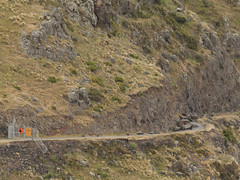
20121117_0314_1D3-200 Summit Road - Closed
Images, eqnz.chch.2010
Obvious seeing why the Summit Road has been closed below Mt Cavendish since the February 22 2011 earthquake. There are some large rocks there!