
A photograph submitted by Jenny to the QuakeStories website. The description reads, "Hereford Street a couple of minutes after the quake. Dust from collapsed buildings visible in the background looking towards High Street.".

Taken several days after the 6.3 magnatude quake hit Christchurch 22 February 2011. Processed in HDR to capture some of the "feeling" when thinking about the loss of lives when the quake hit.

Taken several days after the 6.3 magnatude quake hit Christchurch 22 February 2011. Processed in HDR to capture some of the "feeling" when thinking about the loss of lives when the quake hit.

Taken several days after the 6.3 magnatude quake hit Christchurch 22 February 2011. Processed in HDR to capture some of the "feeling" when thinking about the loss of lives when the quake hit.

A page banner promoting an article titled, "Police quake work marked".

A page banner promoting an article subtitled, "Post-quake garage cuisine".

A page banner promoting an article titled, "Quake movie reopens cinema".

A photograph captioned by Paul Corliss, "Quake City posters, Garlands Road".

A page banner for a feature titled, 'After the Quake 2010'.

Photograph captioned by Fairfax, "Windows in Lyttelton damaged after the quake".
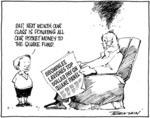
A small boy proudly tells his father 'Next month our class is donating all our pocket money to the quake fund'. His father, who is sitting in an armchair reading a newspaper with a headline that says 'Brownlee lavishes top dollar pay on quake panel' is so furious that steam pours out of his head. Context - The public has been very generous with donations to victims of the Christchurch earthquakes. Questions are now being asked about the Christchurch City Council's handling of consultants' contracts (to do with the rebuilding of the city after the earthquakes). City councillors have been questioning the council's awarding of more than $2.8 million of contracts to consultants.
Quantity: 1 digital cartoon(s).

Shows the face of a man with a large tear rolling down his cheek ; in the tear is the word 'Christchurch'. Context - On 22 February 2011 at 12:51 pm (NZDT), Christchurch experienced a major magnitude 6.3 earthquake, which resulted in severe damage and many casualties. A National State of Emergency has been declared. This followed on from an original magnitude 7.1 earthquake on 4 September 2010 which did far less damage and in which no-one died.
Quantity: 1 digital cartoon(s).

Someone is writing and suddenly the pen runs across the paper. He asks 'Did you feel that?' Refers to continuing aftershocks in Christchurch.
Quantity: 1 digital cartoon(s).

A photograph of a sign in the Canterbury Quakes exhibition at the Canterbury Museum. The sign displays information about the 4 September 2010 earthquake.
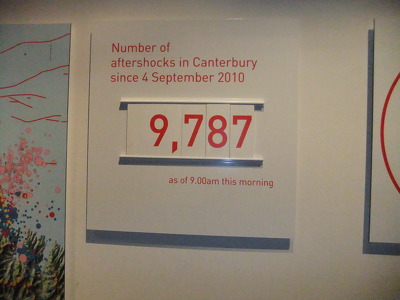
A photograph of a sign in the Canterbury Quakes exhibition at the Canterbury Museum. The sign displays the number of aftershocks in Canterbury since the 4 September 2010 earthquake as of 9.00 am on the morning the photograph was taken. The tally was 9,787.

A photograph of a sign in the Canterbury Quakes exhibition at the Canterbury Museum. The sign displays information about the 23 December 2011 earthquake.

A photograph of a sign in the Canterbury Quakes exhibition at the Canterbury Museum. The sign displays information about the 13 June 2011 earthquake.

A digitally manipulated image of liquefaction around a house in Avondale. The photographer comments, "The bottom of the gates were swallowed up by liquefaction, but the house still looked in good condition, which was confirmed by builders just going in to work on the property. It is in the Christchurch red zone, which after testing has been deemed unsuitable for houses to be built on. All the land will be bought by the Government and they would also buy any properties that could be repaired. The remaining insured property owners will get a payment from the insurance company. All the buildings are condemned to be knocked down".

Grass growing through liquefaction silt in Avondale. The photographer comments, "Although this grass seems to be growing on the liquefaction created by the earthquakes in Christchurch, New Zealand, they are actually only growing through it. Nothing seems to grow even though seeds will sprout almost anywhere else. The seeds are growing in the soil which got covered up by the liquefaction. If liquefaction gets mixed with even a little soil then nature can get a foothold".

A photograph of a sign in the Canterbury Quakes exhibition at the Canterbury Museum. The sign displays information about the 22 February 2011 earthquake.

None

None

None

None

None

None

None

None

A photograph submitted by Anonymous to the QuakeStories website. The description reads, "Strategy Building".

A photograph submitted by Andy Palmer to the QuakeStories website. The description reads, "Lyttelton Plunket Rooms. 25 Feb 2012.".
