
Search
found 6322 results
Images for Canterbury earthquakes; more images...

Christchurch Press Image: Richard Cosgrove, 2011:02:22 13:19:50
Images, UC QuakeStudies
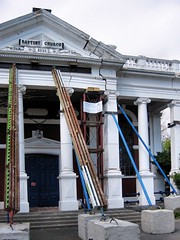
Photograph captioned by Fairfax, "Earthquake damage in central Christchurch after a 6.3 earthquake. Collapsed Canterbury Provincial Chambers".
Examining the spatial and temporal patterns of crime in pre- and post-eart…
Research papers, University of Canterbury Library
The 2010-2011 Canterbury Earthquakes brought devastation to the city of Christchurch and has irrevocably affected the lives of the city’s residents. Years after the conclusion of these earthquakes, Christchurch and its residents are well on the path to recovery. Crime has proven an ongoing topic of discussion throughout this period, with news reports of increased burglary and arson in areas left largely abandoned by earthquake damage, and a rise in violent crime in suburban areas of Christchurch. Following the body of research that has considered the reaction of crime to natural disasters, this research has sought to comprehensively examine and understand the effects that the Canterbury Earthquakes had on crime. Examining Christchurch-wide offending, crime rates fell over the study period (July 2008 to June 2013), with the exception of domestic violence. Aside from a momentary increase in burglary in the days immediately following the Christchurch Earthquake, crime rates (as of 2013) have remained largely below pre-earthquake levels. Using Dual Kernel Density Estimation Analysis, a distinct spatial change in pre-earthquake crime hotspots was observed. These changes included an enormous decrease in central city offences, a rise in burglary in the eastern suburbs, and an increase in assault in areas outside of the central city. Logistic regression analysis, using a time-compensated dependent variable, identified a number of statistically-significant relationships between per CAU crime rate change and factors measuring socio-demographic characteristics, community cohesion, and the severity of disaster effects. The significance of these findings was discussed using elements of Social Disorganisation Theory, Routine Activity Theory, and Strain Theory. Consistent with past findings, social order was largely maintained following the Canterbury Earthquakes, with suggestion that increased collective efficacy and therapeutic communities had a negative influence on crime in the post-earthquake period. Areas of increased burglary and assault were associated with large population decreases, suggesting a link with the dissolution of communities and the removal of their inherent informal guardianship. Though observed, the increase in domestic violence was not associated with most neighbourhood-level variables. Trends in crime after the Canterbury Earthquakes were largely consistent with past research, and the media’s portrayal.
SPCA Canterbury Photograph 11
Images, UC QuakeStudies
A photograph of a veterinarian giving instructions about the health of cats being relocated after the 22 February 2011 earthquake.
SPCA Canterbury Photograph 18
Images, UC QuakeStudies
A photograph of SPCA Inspector Christoff Heyns checking in a rabbit which was displaced by the 22 February 2011 earthquake.
Ella's Story
Articles, UC QuakeStudies
Summary of oral history interview with Ella about her experiences of the Canterbury earthquakes.
Christchurch Earthquake 22/02/11
Images, eqnz.chch.2010
Christchurch Cathedral, Cathedral Square
Christchurch Earthquake 22/02/11
Images, eqnz.chch.2010
Christchurch Cathedral, Cathedral Square
Digital Photograph: North side of London Street, Lyttelton
Images, Canterbury Museum
One landscape colour digital photograph taken on 19 November 2011 showing part of the north side of London Street. The properties visible in the photograph are (from left to right) Tommy Changs Café, Canterbury Street, site of theatre erected for the Loons Circus Theatre Company production of Macbeth (being dismantled), Lyttel Arthouse (closed),...
Digital Photograph: North side of London Street, Lyttelton
Images, Canterbury Museum
One landscape colour digital photograph taken on 19 November 2011 showing buildings on London Street. Visible in the photograph (left to right) are Bells Pharmacy - relocated into a converted house with law firm MacTodd on the upper floor, Portico (gift shop), Tommy Changs Cafe, and the edge of the Lyttelton Petanque Club Gap Filler initiative. ...
Digital Photograph: Corner of London and Canterbury Streets, Lyttelton
Images, Canterbury Museum
One landscape colour digital photograph taken on 19 November 2011 showing the site of the Albion Hotel/ Ground Delicatessen. After the demolition of the building the site was used for a Gap Filler initiative called the Lyttelton Petanque Club. The photograph shows the temporary furniture, landscaping and public Petanque court. The site formerl...
Digital Photograph: North side of London Street, Lyttelton
Images, Canterbury Museum
One landscape colour digital photograph taken on 19 November 2011 showing part of the north side of London Street. The properties visible from left to right are: Himalaya Design (obscured), Coffee Culture (downstairs), J Voyce and Co Ships Providore (upstairs), empty shop, and Lyttel Piko Organic and Wholefoods The Lyttelton streetscape has cha...
Digital Photograph: North side of London Street, Lyttelton
Images, Canterbury Museum
One landscape colour digital photograph taken on 19 November 2011 showing part of the north side of London Street. The properties visible from left to right are: part of Lyttel Piko Organic and Wholefoods, Satchmo Café Pizzabar, Milly May and Snoclothes New Zealand. The empty section was formerly occupied by No. 6 Cafe. The Lyttelton streetsc...
Digital Photograph: Godley Head Lighthouse
Images, Canterbury Museum
One landscape colour digital photograph taken on 26 May 2013 showing the Godley Head Lighthouse and cliffs. Taken from the entrance to Lyttelton Harbour looking north. The Godley Head Lighthouse (K4286) was discontinued on 6 July 2012. Volcanic banding is visible in the face of the cliffs. There were several major rock falls along the coastal ...
Digital Photograph: Looking east from Norwich Quay, Lyttelton
Images, Canterbury Museum
One landscape colour digital photograph taken on 19 November 2011 looking east from Norwich Quay from approximately the base of Canterbury Street. Visible in the photograph are the partially deconstructed former Lyttelton Harbour Board Offices, the Holcim Cement Silos, the Oxford Street Railway Overbridge, Lyttelton Port of Christchurch's storag...
Digital Photograph: Shadbolt House, Norwich Quay, Lyttelton
Images, Canterbury Museum
One portrait colour digital photograph taken on 19 November 2011 showing Shadbolt House prior to its demolition. Architect Lyttelton's tallest building before its demolition was built in 1961 as the offices of the Lyttelton Harbour Board. At the time it was demolished the building was known as Shadbolt House and was owned by Independent Fisherie...
Digital Photograph: Elevated view of London Street, Lyttelton
Images, Canterbury Museum
One landscape colour digital photograph taken on 26 May 2013 of London Street, Lyttelton. The photograph was taken from St Davids Street looking west. The roofs of the portable buildings forming the temporary Lyttelton Police station are visible in the foreground. The Lyttelton Port Company offices and Tunnel Portal are prominent in the midgrou...
Digital Photograph: Norwich Quay, Lyttelton.
Images, Canterbury Museum
One landscape colour digital photograph taken on 26 May 2013 on the corner of Norwich Quay and Canterbury Street, Lyttelton. The photograph shows the sites of the Royal Hotel, Shadbolt House, and the Lyttelton Hotel along Norwich Quay. The Wunderbar and the repair and strengthening work underway on the Lyttelton Working Mens Club/The Loons are v...
Digital Photograph: Godley Head, Lyttelton Harbour
Images, Canterbury Museum
One landscape colour digital photograph taken on 26 May 2013 off Godley Head looking north to Boulder Bay and Taylors Mistake. Rock which fell from the cliffs is heaped at the waters edge. Volcanic banding is visible in the face of the cliffs. There were several major rock falls along the coastal cliffs near Christchurch and Lyttelton Harbour....
Digital Photograph: Sumner Head
Images, Canterbury Museum
One landscape colour digital photograph taken on 26 May 2013 off Godley Head looking north towards Sumner Head. There were several major rock falls along the coastal cliffs near Christchurch and Lyttelton Harbour. In and around the suburb of Sumner some of these falls necessitated the abandonment of houses in areas where cliffs had given way or...
Digital Photograph: Demolition of the Empire Hotel, London Street, Lyttelt…
Images, Canterbury Museum
One landscape colour digital photograph taken on 19 April 2011 showing the demolition of the Empire Hotel on London Street. The photograph shows the façade of the hotel supported by the framework installed to brace the building after the 4 September 2010 earthquake. A crane is being used to enable the east wall to be demolished by hand to avoid...
Digital Photograph: Former Convent of Our Lady of Mercy, Exeter Street, Ly…
Images, Canterbury Museum
One landscape colour digital photograph taken on 25 September 2011 showing the remaining portion of the former Convent of Our Lady of Mercy. St Mary's School, run by the Sisters of Mercy, was also housed in this building. At the time of the 4 September 2010 earthquake the building was a private residence. The picture shows the perimeter wall, t...
Christchurch City Council : your people, your city.
Other, National Library of New Zealand
A wide range of information about Council business and services, bylaws, public activities. Includes media releases and information about events and facilities in Christchurch. Earthquake related information can be found in the archived instances from September 2010-
Christchurch Central Development Unit.
Other, National Library of New Zealand
Site of CCDU, the Government agency responsible for rebuilding Christchurch after the earthquakes and resulting demolition. Includes vision for the city, profile of the director, reasons to invest in Christchurch central, work programme for the unit, and video file.
Christchurch Earthquake 22/02/11
Images, eqnz.chch.2010
Christchurch Cathedral, photo taken from the Warners Novotel, Cathedral Square.
Politics with Andrew Campbell and Matthew Hooton
Audio, Radio New Zealand
The Government's response to the Canterbury earthquake, and the South Canterbury Finance bail-out and republicanism.
Letter from Vice Chancellor of the University of Canterbury Dr Rod Carr
Articles, UC QuakeStudies
Vice Chancellor of the University of Canterbury Dr Rod Carr writes about the 2010 Canterbury Earthquake.
Photo 085
Images, UC QuakeStudies
Liquefaction-damaged carpets removed from a residential propoerty in Pines Beach, after the September 4th earthquake.
Photo 017
Images, UC QuakeStudies
A large crack in the centre of a street in Avonside after the September 4th earthquake.
Photo 009
Images, UC QuakeStudies
A large crack in the centre of a street in Avonside after the September 4th earthquake.
Photo 019
Images, UC QuakeStudies
A large crack in the centre of a street in Avonside after the September 4th earthquake.