
Search
found 6322 results
Images for Canterbury earthquakes; more images...

Observatory Tower Photograph 13
Images, UC QuakeStudies
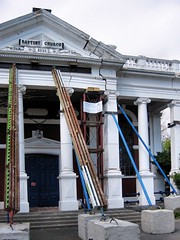
A close-up photograph of parts of the Townsend Telescope recovered from the rubble of the Observatory tower. The telescope was housed in the tower at the Christchurch Arts Centre. It was severely damaged when the tower collapsed during the 22 February 2011 earthquake.
Observatory Tower Photograph 18
Images, UC QuakeStudies
A photograph of the earthquake damage to the second story of the Observatory tower at the Christchurch Arts Centre. The front of the storey has collapsed, exposing the inside. A tarpaulin has been draped over the top and the roof of the building behind.
North Island quake could trigger Ruapehu lahar
Audio, Radio New Zealand
A very large earthquake in the central North Island could trigger a big lahar from Mt Ruapehu. In the recent past it's been eruptions that have led to lahars on the mountain. But scientists from Canterbury University have checking what else might cause cause mud and debris to spew out of the crater lake.
Thesis Report by Shermine Kwok
Articles, UC QuakeStudies
An honours-level thesis report by Shermine Kwok, an undergraduate student from the National University of Singapore. Shermine attended the University of Canterbury on an exchange in 2012. Inspired by the resilience of Christchurch and its residents, she returned to Christchurch to study the creative urban regeneration efforts since the earthquakes of 2010 - 2011.
Organ rising from the rubble
Audio, Radio New Zealand
Canterbury organist Martin Setchell gives the inaugural recital on an organ that’s more than 100 years old. He explains how the instrument survived the February 22nd earthquake even though the church crumbled around it, why it was important to save it, and how the latest technology has being integrated into the restored organ..
Modelling geodetic observations of postseismic displacement in the central…
Research papers, Victoria University of Wellington
The last seven years have seen southern New Zealand a ected by several large and damaging earthquakes: the moment magnitude (MW) 7.8 Dusky Sound earthquake on 15 July 2009, the MW 7.1 Dar eld (Canterbury) earthquake on 4 September 2010, and most notably the MW 6.2 Christchurch earthquake on 22 February 2011 and the protracted aftershock sequence. In this thesis, we address the postseismic displacement produced by these earthquakes using methods of satellite-based geodetic measurement, known as Interferometric Synthetic Aperture Radar (InSAR) and Global Positioning System (GPS), and computational modelling. We observe several ground displacement features in the Canterbury and Fiordland regions during three periods: 1) Following the Dusky Sound earthquake; 2) Following the Dar eld earthquake and prior to the Christchurch earthquake; and 3) Following the Christchurch earthquake until February 2015. The ground displacement associated with postseismic motion following the Dusky Sound earthquake has been measured by continuous and campaign GPS data acquired in August 2009, in conjunction with Di erential Interferometric Synthetic Aperture Radar (DInSAR) observations. We use an afterslip model, estimated by temporal inversion of geodetic data, with combined viscoelastic rebound model to account for the observed spatio-temporal patterns of displacement. The two postseismic processes together induce a signi cant displacement corresponding to principal extensional and contractual strain rates of the order of 10⁻⁷ and 10⁻⁸ yr⁻¹ respectively, across most of the southern South Island. We also analyse observed postseismic displacement following the Dusky Sound earthquake using a new inversion approach in order to describe afterslip in an elasticviscoelastic medium. We develop a mathematical framework, namely the "Iterative Decoupling of Afterslip and Viscoelastic rebound (IDAV)" method, with which to invert temporally dense and spatially sparse geodetic observations. We examine the IDAV method using both numerical and analytical simulations of Green's functions. For the post-Dar eld time interval, postseismic signals are measured within approximately one month of the mainshock. The dataset used for the post-Dar eld displacement spans the region surrounding previously unrecognised faults that ruptured during the mainshock. Poroelastic rebound in a multi-layered half-space and dilatancy recovery at shallow depths provide a satisfactory t with the observations. For the post-Christchurch interval, campaign GPS data acquired in February 2012 to February 2015 in four successive epochs and 66 TerraSAR-X (TSX) SAR acquisitions in descending orbits between March 2011 and May 2014 reveal approximately three years of postseismic displacement. We detect movement away from the satellite of ~ 3 mm/yr in Christchurch and a gradient of displacement of ~ 4 mm/yr across a lineament extending from the westernmost end of the Western Christchurch Fault towards the eastern end of the Greendale East Fault. The postseismic signals following the Christchurch earthquake are mainly accounted for by afterslip models on the subsurface lineament and nearby faults.
Nisbet, Alistair, 1958- :'What's that noise Bob...Quake? A leak?' 30 Janua…
Images, Alexander Turnbull Library
Inside the Christchurch City Council building someone wonders what that noise is. Outside a gigantic wave of 'public discontent' rushes towards them. Context: Relates to anger and a protest of 4000 people at what they see as poor performance by the City Council in dealing with earthquake issues. The final straw was the Council's decision on the advice of its consultants to award the Council Chief Executive Tony Marryatt a $68,000 14% pay rise mid December 2011. Quantity: 1 digital cartoon(s).
Nisbet, Alistair, 1958- :'Psssssssst! Drop it boy... and we'll bounce it '…
Images, Alexander Turnbull Library
Chief executive of the Christchurch City Council, Tony Marryatt, has announced he has turned down a controversial $68,000 pay rise. The pay rise is particularly controversial in the face of widespread hardship in Christchurch because of the earthquakes that began in September 2010 and continue still. Quantity: 1 digital cartoon(s).
EVALUATING LIQUEFACTION POTENTIAL OF PUMICEOUS DEPOSITS THROUGH FIELD TEST…
Research papers, University of Canterbury Library
Pumice materials, which are problematic from an engineering viewpoint, are widespread in the central part of the North Island. Considering the impacts of the 2010-2011 Christchurch earthquakes, a clear understanding of their properties under earthquake loading is necessary. For example, the 1987 Edgecumbe earthquake showed evidence of localised liquefaction of sands of volcanic origin. To elucidate on this, research was undertaken to investigate whether existing empirical field-based methods to evaluate the liquefaction potential of sands, which were originally developed for hard-grained soils, are applicable to crushable pumice-rich deposits. For this purpose, two sites, one in Whakatane and another in Edgecumbe, were selected where the occurrence of liquefaction was reported following the Edgecumbe earthquake. Manifestations of soil liquefaction, such as sand boils and ejected materials, have been reported at both sites. Field tests, including cone penetration tests (CPT), shear-wave velocity profiling, and screw driving sounding (SDS) tests were performed at the sites. Then, considering estimated peak ground accelerations (PGAs) at the sites based on recorded motions and possible range of ground water table locations, liquefaction analysis was conducted at the sites using available empirical approaches. To clarify the results of the analysis, undisturbed soil samples were obtained at both sites to investigate the laboratory-derived cyclic resistance ratios and to compare with the field-estimated values. Research results clearly showed that these pumice-rich soils do not fit existing liquefaction assessment frameworks and alternate methods are necessary to characterise them.
Photographs of central Christchurch after the 2010 and 2011 earthquakes
Images, Alexander Turnbull Library
Photographs of central Christchurch after the 2010-2012 earthquakes taken 25 February 2012 by Sean McMahon. Locations are chiefly Manchester, Saint Asaph, Cashel, Columbo and Lichfield Streets, and the Bridge of Remembrance. Images show fencing around areas closed to the public, damaged and collapsed commercial buildings, cleared sites, re-opened Cashel Street area with shops and a cafe. Source of title - Title supplied by Library Quantity: 34 digital photograph(s).
WEMO ERT Set 1 - March 2011 - Photograph 97
Images, UC QuakeStudies
A photograph of the earthquake-damaged Stone Chamber of the Canterbury Provincial Council Buildings on Durham Street North. Large sections of the Chamber have collapsed and the masonry and other rubble has spilled onto the footpath in front. To the left scaffolding constructed up the side of the building has also collapsed and twisted out of shape. Wire fences have been placed along the side of the building as a cordon.
Hazard from post-earthquake landslides : assessing the temporal and spatia…
Research papers, University of Canterbury Library
Landslides are significant hazards, especially in seismically-active mountainous regions, where shaking amplified by steep topography can result in widespread landsliding. These landslides present not only an acute hazard, but a chronic hazard that can last years-to-decades after the initial earthquake, causing recurring impacts. The Mw 7.8 Kaikōura earthquake caused more than 20,000 landslides throughout North Canterbury and resulted in significant damage to nationally significant infrastructure in the coastal transport corridor (CTC), isolating Kaikōura from the rest of New Zealand. In the years following, ongoing landsliding triggered by intense rainfall exacerbated the impacts and slowed the recovery process. However, while there is significant research on co-seismic landslides and their initial impacts in New Zealand, little research has explored the evolution of co-seismic landslides and how this hazard changes over time. This research maps landslides annually between 2013 and 2021 to evaluate the changes in pre-earthquake, co-seismic and post-earthquake rates of landsliding to determine how landslide hazard has changed over this time. In particular, the research explores how the number, area, and spatial distribution of landslides has changed since the earthquake, and whether post-earthquake mitigation works have in any way affected the long-term landslide hazard. Mapping of landslides was undertaken using open-source, medium resolution Landsat-8 and Sentinel-2 satellite imagery, with landslides identified visually and mapped as single polygons that capture both the source zone and deposit. Three study areas with differing levels of post-earthquake mitigation are compared: (i) the northern CTC, where the majority of mitigation was in the form of active debris removal; (ii) the southern CTC, where mitigation was primarily via passive protection measures; and (iii) Mount Fyffe, which has had no mitigation works since the earthquake. The results show that despite similar initial impacts during the earthquake, the rate of recovery in terms of landslide rates varies substantially across the three study areas. In Mount Fyffe, the number and area of landslides could take 45 and 22 years from 2021 respectively to return to pre-earthquake levels at the current rate. Comparatively, in the CTC, it could take just 5 years and 3-4 years from 2021 respectively. Notably, the fastest recovery in terms of landslide rates in the CTC was primarily located directly along the transport network, whereas what little recovery did occur in Mount Fyffe appeared to follow no particular pattern. Importantly, recovery rates in the northern CTC were notably higher than in the southern CTC, despite greater co-seismic impacts in the former. Combined, these results suggest the active, debris removal mitigation undertaken in the northern CTC may have had the effect of dramatically reducing the time for landslide rates to return to pre-earthquake levels. The role of slope angle and slope aspect were explored to evaluate if these observations could be driven by local differences in topography. The Mount Fyffe study area has higher slope angles than the CTC as a whole and landslides predominantly occurred on slightly steeper slopes than in the CTC. This may have contributed to the longer recovery times for landsliding in Mount Fyffe due to greater gravitational instability, however the observed variations are minor compared to the differences in recovery rates. In terms of slope aspect, landslides in Mount Fyffe preferentially occurred on north- and south-facing slopes whereas landslides in the CTC preferred the east- and south-facing slopes. The potential role of these differences in landslide recovery remains unclear but may be related to the propagation direction of the earthquake and the tracking direction of post-earthquake ex-tropical cyclones. Finally, landslides in the CTC are observed to be moving further away from the transport network and the number of landslides impacting the CTC decreased significantly since the earthquake. Nevertheless, the potential for further landslide reactivation remains. Therefore, despite the recovery in the CTC, it is clear that there is still risk of the transport network being impacted by further landsliding, at least for the next 3-5 yrs.
Fairfax Video, May 2013 (1)
Videos, UC QuakeStudies
A video about the ten most influential people in The Press 2013 Power List. The top ten are Prime Minister John Key, Canterbury Earthquake Recovery Minister Gerry Brownlee, Kaiwhakahaere of Te Runanaga o Ngai Tahu Mark Soloman, EQC Chief Executive Ian Simpson, Environment Canterbury Chairperson Dame Margaret Bazley, CERA Chief Executive Roger Sutton, The Press Editor Joanna Norris, IAG Chief Executive Jacki Johnson, Tertiary Education Minister Steven Joyce, and Minister of Education Hekia Parata.
Elric Hooper
Audio, Radio New Zealand
Elric Hooper is a recognisable face in Christchurch theatre both on and off stage. He spent his early years with Dame Ngaio Marsh, the influential woman for whom the theatre at The University of Canterbury was named after. The theatre was damaged during the Christchurch earthquakes and is now under threat. But is it worth keeping it?
Christchurch Press 30 June 2012: Section A, Page 5
Articles, UC QuakeStudies
Page 5 of Section A of the Christchurch Press, published on Saturday 30 June 2012.
Christchurch Press 13 December 2012: Section A, Page 5
Articles, UC QuakeStudies
Page 5 of Section A of the Christchurch Press, published on Thursday 13 December 2012.
Christchurch Press 7 September 2012: Section A, Page 3
Articles, UC QuakeStudies
Page 3 of Section A of the Christchurch Press, published on Friday 7 September 2012.
Christchurch Press 8 September 2012: Section A, Page 2
Articles, UC QuakeStudies
Page 2 of Section A of the Christchurch Press, published on Saturday 8 September 2012.
Christchurch Press 14 December 2011: Section A, Page 3
Articles, UC QuakeStudies
Page 3 of Section A of the Christchurch Press, published on Wednesday 14 December 2011.
The Star 13 July 2012
Articles, UC QuakeStudies
A PDF copy of The Star newspaper, published on Friday 13 July 2012.
Christchurch Press 9 August 2012: Section A, Page 2 (Christchurch Edition)
Articles, UC QuakeStudies
Page 2 of Section A of the Christchurch edition of the Christchurch Press, published on Thursday 9 August 2012.
Christchurch Press 7 March 2012: Section A, Page 1 (Christchurch Edition)
Articles, UC QuakeStudies
Page 1 of Section A of the Christchurch edition of the Christchurch Press, published on Wednesday 7 March 2012.
Christchurch Press 30 July 2013: Section A, Page 1
Articles, UC QuakeStudies
Page 1 of Section A of the Christchurch Press, published on Tuesday 30 July 2013.
Christchurch Press 1 March 2014: Section C, Page 3
Articles, UC QuakeStudies
Page 3 of Section C of the Christchurch Press, published on Saturday 1 March 2014.
Christchurch Press 17 July 2012: Section A, Page 3
Articles, UC QuakeStudies
Page 3 of Section A of the Christchurch Press, published on Tuesday 17 July 2012.
Well, yes
Images, eqnz.chch.2010
Makes sense that the end of the detour is where the road closes, right? msh1014: 12. Dead End
Nisbet, Alistair, 1958- :The next Mayoral overseas venture?...' 4 February…
Images, Alexander Turnbull Library
A plane flies into the distance. Attached to it by a rope is a large package containing Christchurch Mayor Bob Parker and CEO of the City Council Tony Marryatt. The package is addressed 'Deepest Siberia c/- isolated hellhole Russia'. The mayor looks on the bright side considering this to be a junket the people will approve of. Context: Public disapproval of the Mayor's two-week tour of Asian countries with a Christchurch International Airport-led delegation. The airport is paying for the mayoral couple to take part in the trip. There is public criticism that the trip take place at this time because of ongoing problems with the council and earthquake recovery. There is also criticism of Tony Marryatt's $68,000 pay increase considered poor form when so many people are struggling with earthquake related problems. Quantity: 1 digital cartoon(s).
Liquefaction evaluation in stratified soils.
Research papers, University of Canterbury Library
The Canterbury Earthquake Sequence (CES) of 2010-2011 caused widespread liquefaction in many parts of Christchurch. Observations from the CES highlight some sites were liquefaction was predicted by the simplified method but did not manifest. There are a number of reasons why the simplified method may over-predict liquefaction, one of these is the dynamic interaction between soil layers within a stratified deposit. Soil layer interaction occurs through two key mechanisms; modification of the ground motion due to seismic waves passing through deep liquefied layers, and the effect of pore water seepage from an area of high excess pore water pressure to the surrounding soil. In this way, soil layer interaction can significantly alter the liquefaction behaviour and surface manifestation of soils subject to seismic loading. This research aimed to develop an understanding of how soil layer interaction, in particular ground motion modification, affects the development of excess pore water pressures and liquefaction manifestation in a soil deposit subject to seismic loading. A 1-D soil column time history Effective Stress Analysis (ESA) was conducted to give an in depth assessment of the development of pore pressures in a number of soil deposits. For this analysis, ground motions, soil profiles and model parameters were required for the ESA. Deconvolution of ground motions recorded at the surface during the CES was used to develop some acceleration time histories to input at the base of the soil-column model. An analysis of 55 sites around Christchurch, where detailed site investigations have been carried out, was then conducted to identify some simplified soil profiles and soil characteristics. From this analysis, four soil profiles representative of different levels of liquefaction manifestation were developed. These were; two thick uniform and vertically continuous sandy deposits that were representative of sites were liquefaction manifested in both the Mw 7.1 September 2010 and the Mw 6.3 February 2011 earthquakes, and two vertically discontinuous profiles with interlayered liquefiable and non-liquefiable layers representative of sites that did not manifest liquefaction in either the September 2010 or the February 2011 events. Model parameters were then developed for these four representative soil profiles through calibration of the constitutive model in element test simulations. Simulations were run for each of the four profiles subject to three levels of loading intensity. The results were analysed for the effect of soil layer interaction. These were then compared to a simplified triggering analysis for the same four profiles to determine where the simplified method was accurate in predicting soil liquefaction (for the continuous sandy deposits) and were it was less accurate (the vertically discontinuous deposits where soil layer interaction was a factor).
Lived experiences of Bhutanese former refugee youth : coping, resilience a…
Research papers, University of Canterbury Library
This thesis explores the lived experiences of a group of young Bhutanese former refugees between the ages of 18 to 24 years who were resettled in Christchurch between 2008 and 2010 – prior to the first major earthquake. The main goal of the thesis was to gain an understanding of their ways of coping and a second goal was to explore whether their participation in up to five mindfulness infused counselling sessions had influenced their ways of coping. A qualitative research methodology was used to guide the thesis. Participants were interviewed about the major events in their life and how they coped with them. They were then invited to participate in five sessions of mindfulness infused counselling. Approximately five weeks after their final session had ended they were invited to one final interview to explore the influence of the sessions on their ways of coping. Interviews were recorded and transcribed and research notes were taken of the mindfulness infused counselling sessions. Max van Manen’s method of phenomenology was adopted to interpret the narratives of the youth. Three main themes emerged from the data analysis and these are described as essences of lived coping experiences. The first captures their strong sense of community back in the refugee camp. The second presents the sense of resilience that exists among the Bhutanese former refugees. The third essence indicated the inner strengths of the participants which they said helped them deal with the challenging circumstances that life cast in their direction. This meant that their first experience of an earthquake was not considered the biggest event in their lives. After attending the mindfulness infused counselling sessions’ participants reported positive benefits from giving non-judgemental attention to their thoughts and feelings and they found themselves dealing with their issues proactively. For some participants their ‘accepting’ attitude facilitated better control over their emotions while others reported being able to form deeper connections with nature and other people as a result of being mindful. Other participants reported being able to make peace with the events in their past and even found that they were able to forgive those who tormented their community. However, in the absence of any major event in any of the participants’ lives in the time period following their final counselling session, the research was not able to definitely conclude that using mindful-based counselling facilitates better coping in the face extremely stressful events. There is currently very little research that focuses on the experiences of former refugee youth within New Zealand and how they utilize their capacities to deal with adversities. When this thesis commenced, the Bhutanese were the newest refugee community to be accepted for resettlement in New Zealand. This research partly addresses the limited voice of this community.
20131231_8485_EOS M-22 Quake City exhibit
Images, eqnz.chch.2010
Another city walk around, this time with my brother-in-law from Auckland. Also went to the Quake City exhibition in the city organised by the Canterbury Museum. First fine day for a while.