
Search
found 507 results
Images for Canterbury earthquakes; more images...


Geologic and geomorphic influence on the spatial extent of lateral spreadi…
Research papers, University of Canterbury Library
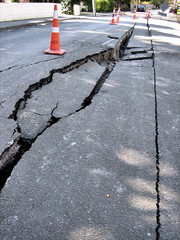
Liquefaction-induced lateral spreading during earthquakes poses a significant hazard to the built environment, as observed in Christchurch during the 2010 to 2011 Canterbury Earthquake Sequence (CES). It is critical that geotechnical earthquake engineers are able to adequately predict both the spatial extent of lateral spreads and magnitudes of associated ground movements for design purposes. Published empirical and semi-empirical models for predicting lateral spread displacements have been shown to vary by a factor of <0.5 to >2 from those measured in parts of Christchurch during CES. Comprehensive post- CES lateral spreading studies have clearly indicated that the spatial distribution of the horizontal displacements and extent of lateral spreading along the Avon River in eastern Christchurch were strongly influenced by geologic, stratigraphic and topographic features.
A System Dynamic Model of Post-Earthquake Reconstruction pathways
Research papers, University of Canterbury Library
Objectives • To develop a system dynamics model of Christchurch post-quake reconstruction process that captures all the critical dynamics influencing its pathway • To investigate the implications of current rebuild pathway • To build a reconstruction module to be integrated in MERIT (Measuring the Economics of Resilient Infrastructure Tool)
Townsend Telescope: Part Photograph 44
Images, UC QuakeStudies
A photograph of the dew and lens cap from the Townsend Telescope. The cap was crushed during the 22 February 2011 earthquake.
Townsend Telescope: Part Photograph 03
Images, UC QuakeStudies
A photograph of the Celestron eyepiece from the Townsend Telescope. The eyepiece was scratched and chipped during the 22 February 2011 earthquake.
Townsend Telescope: Part Photograph 21
Images, UC QuakeStudies
A photograph of a wooden knob from the Townsend Telescope. The knob broke off the telescope during the 22 February 2011 earthquake.
Townsend Telescope: Part Photograph 43
Images, UC QuakeStudies
A photograph of the dew and lens cap from the Townsend Telescope. The cap was crushed during the 22 February 2011 earthquake.
Resilience Examples in Reservoirs, Pump Stations and Pipelines - Lessons L…
Articles, UC QuakeStudies
A paper prepared for the Water New Zealand 2014 conference which considers resilience lessons for reservoirs, pump stations and pipelines.
Addington Rugby Stadium
Images, eqnz.chch.2010
Helicopter Flight over Christchurch New Zealand
Manchester/High Streets
Images, eqnz.chch.2010
Helicopter Flight over Christchurch New Zealand
Observatory Tower Photograph 23
Images, UC QuakeStudies
A photograph of the earthquake damage to the Observatory tower at the Christchurch Arts Centre. The top two storeys of the tower collapsed during the 22 February 2011 earthquake and the rubble spilled into the courtyard in front. A digger was used to clear the rubble away from the building. A tarpaulin has been draped over the top of the tower and the roof of the building behind.
Observatory Tower Photograph 16
Images, UC QuakeStudies
A photograph of the earthquake damage to the Observatory tower at the Christchurch Arts Centre. The top two storeys of the tower collapsed during the 22 February 2011 earthquake and the rubble spilled into the courtyard in front. A digger was used to clear the rubble away from the building. A tarpaulin has been draped over the top of the broken tower and the roof behind.
Observatory Tower Photograph 17
Images, UC QuakeStudies
A photograph of the earthquake damage to the Observatory tower at the Christchurch Arts Centre. The top two storeys of the tower collapsed during the 22 February 2011 earthquake and the rubble spilled into the courtyard in front. A digger was used to clear the rubble away from the building. A tarpaulin has been draped over the top of the broken tower and the roof behind.
Observatory Tower Photograph 32
Images, UC QuakeStudies
A photograph of the earthquake damage to the Observatory tower at the Christchurch Arts Centre. The top two storeys of the tower collapsed during the 22 February 2011 earthquake and the rubble spilled into the courtyard in front. A digger was used to clear the rubble away from the building. A tarpaulin has been draped over the top of the broken tower and the roof behind.
Townsend Telescope: Part Photograph 56
Images, UC QuakeStudies
A photograph of some of the parts of the Townsend Telescope. Many of the parts were damaged during the 22 February 2011 earthquake.
Townsend Telescope: Part Photograph 55
Images, UC QuakeStudies
A photograph of the declinator readout ring from the Townsend Telescope. The ring was chipped and scratched during the 22 February 2011 earthquake.
Townsend Telescope: Part Photograph 22
Images, UC QuakeStudies
A photograph of the knurled knob from the Townsend Telescope. The teeth of the knob were damaged during the 22 February 2011 earthquake.
Townsend Telescope: Part Photograph 64
Images, UC QuakeStudies
A photograph of the object end of the finderscope from the Townsend Telescope. The finderscope was damaged during the 22 February 2011 earthquake.
Townsend Telescope: Part Photograph 65
Images, UC QuakeStudies
A photograph of the object end of the finderscope from the Townsend Telescope. The finderscope was damaged during the 22 February 2011 earthquake.
Unreinforced Masonry Churches in New Zealand Towards a Holistic Framework …
Research papers, University of Canterbury Library
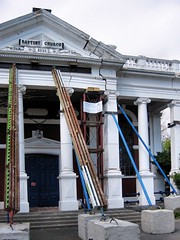
Unreinforced masonry churches in New Zealand, similarly to everywhere else in the word have proven to be highly vulnerable to earthquakes, because of their particular construction features. The Canterbury (New Zealand) earthquake sequence, 2010-2011 caused an invaluable loss of local architectural heritage and of churches, as regrettably, some of them were demolished instead of being repaired. It is critical for New Zealand to advance the data collection, research and understanding pertaining to the seismic performance and protection of church buildings, with the aim to:
Townsend Telescope: Part Photograph 12
Images, UC QuakeStudies
A photograph of a collar from the Townsend Telescope. Part of the collar was bent out of shape during the 22 February 2011 earthquake.
Townsend Telescope: Part Photograph 13
Images, UC QuakeStudies
A photograph of a slow motion rod from the Townsend Telescope. The rod was bent out of shape during the 22 February 2011 earthquake.
Townsend Telescope: Part Photograph 15
Images, UC QuakeStudies
A photograph of a slow motion knob and shaft from the Townsend Telescope. The knob broke off the shaft during the 22 February 2011 earthquake.
Townsend Telescope: Part Photograph 46
Images, UC QuakeStudies
A photograph of the weight for the clock drive from the Townsend Telescope. The weight was chipped and scratched during the 22 February 2011 earthquake.
Townsend Telescope: Part Photograph 47
Images, UC QuakeStudies
A photograph of the declinator axle and counterweight from the Townsend Telescope. The axle broken off from the weight during the 22 February 2011 earthquake.
Performance of Earthquake Damage Beams Repaired via Epoxy Injection
Research papers, University of Canterbury Library
The purpose of this research is to investigate men’s experiences of the 2016 7.8 magnitude Kaikōura earthquake and Tsunami. While, research into the impacts of the earthquake has been conducted, few studies have examined how gender shaped people’s experiences of this natural hazard event. Analysing disasters through a gender lens has significantly contributed to disaster scholarship in identifying the resilience and vulnerabilities of individuals and communities pre- and post-disaster (Fordham, 2012; Bradshaw, 2013). This research employs understandings of masculinities (Connell, 2005), to examine men’s strengths and challenges in responding, recovering, and coping following the earthquake. Qualitative inquiry was carried out in Northern Canterbury and Marlborough involving 18 face-to-face interviews with men who were impacted by the Kaikōura earthquake and its aftermath. Interview material is being analysed using thematic and narrative analysis. Some of the preliminary findings have shown that men took on voluntary roles in addition to their fulltime paid work resulting in long hours, poor sleep and little time spent with family. Some men assisted wives and children to high ground then drove into the tsunami zone to check on relatives or to help evacuate people. Although analysis of the findings is currently ongoing, preliminary findings have identified that the men who participated in the study have been negatively impacted by the 2016 Kaikōura earthquake. A theme identified amongst participants was an avoidance to seek support with the challenges they were experiencing due to the earthquake. The research findings align with key characteristics of masculinity, including demonstrating risky behaviours and neglecting self or professional care. This study suggests that these behaviours affect men’s overall resilience, and thus the resilience of the wider community.
Repairing Christchurch City Council Owned Retaining Walls Damaged by the C…
Articles, UC QuakeStudies
A paper which outlines SCIRT's approach to asset assessment, design and repair of damaged retaining walls, and presents a case study of a retaining wall rebuild, on Cunningham Terrace, Lyttelton.
Observatory Tower Photograph 37
Images, UC QuakeStudies
A photograph of the earthquake-damaged Observatory tower at the Christchurch Arts Centre. The photograph was taken using a cellphone camera. The top of the tower collapsed during the 22 February 2011 earthquake. The rubble from the tower has been cleared and a tarpaulin has been placed over the top of the broken tower. Tyres have been placed on the tarpaulin to hold it down. A temporary roof has also been constructed over the tower to keep out the rain.
Townsend Telescope: Part Photograph 29
Images, UC QuakeStudies
A photograph of the lower end of the main tube of the Townsend Telescope. The tube was crushed and bent during the 22 February 2011 earthquake.
Townsend Telescope: Part Photograph 25
Images, UC QuakeStudies
A photograph of a bolt head from the Townsend Telescope. The bolt head broke off one of the telescope's bolts during the 22 February 2011 earthquake.
Townsend Telescope: Part Photograph 27
Images, UC QuakeStudies
A photograph of the lower end of the main tube of the Townsend Telescope. The tube was crushed and bent during the 22 February 2011 earthquake.