
Search
found 3861 results
Images for Canterbury earthquakes; more images...


Christchurch’s new $92m library opens to much fanfare
Audio, Radio New Zealand
Christchurch’s new $92m central city library opened today – replacing the former library which was damaged in the Canterbury earthquakes. But as Logan Church discovers, with sewing suites, a TV wall and a music studio, this library is home to more than rows and rows of books.
New quake safety doubts over police stations, hospitals
Audio, Radio New Zealand
It's been revealed that not a single one of New Zealand's 315 police buildings constructed before 2011 have had a full earthquake safety check. Canterbury's district health buildings and a central Wellington cinema are among other major structures needing checks. Phil Pennington joins us with the details.
Hubbard, James, 1949- :"It's because they're high calibre people!" 21 July…
Images, Alexander Turnbull Library
The cartoon depicts the Minister of Earthquakes Gerry Brownlee, with a portaloo in place of a head. He holds in his hand a document which reads 'Govt appointed quake panel (Shipley etc) paid twice normal fees: $1000 - 1400 daily'. A voice from inside the toilet says 'It's because they're high calibre people!' Context: Earthquake Recovery Minister Gerry Brownlee lobbied his colleagues to pay a Government-appointed panel more than twice the recommended rate because he claimed they would not do it for less - even though he never asked them. On Mr Brownlee's advice, the Cabinet more than doubled the pay rates for the panel from the recommended fees, which was a daily rate of $360 to $655 for the panel chairman and $270 to $415 for panel members. The Cabinet increased this to $1400 a day for the chairman and $1000 a day for the other members. (NZ Herald, 9 August 2011) Quantity: 1 digital cartoon(s).
Ground motion simulation validation with explicit uncertainty incorporatio…
Research papers, University of Canterbury Library
This study investigates the uncertainty of simulated earthquake ground motions for smallmagnitude events (Mw 3.5 – 5) in Canterbury, New Zealand. 148 events were simulated with specified uncertainties in: event magnitude, hypocentre location, focal mechanism, high frequency rupture velocity, Brune stress parameter, the site 30-m time-averaged shear wave velocity (Vs30), anelastic attenuation (Q) and high frequency path duration. In order to capture these uncertainties, 25 realisations for each event were generated using the Graves and Pitarka (2015) hybrid broadband simulation approach. Monte-Carlo realisations were drawn from distributions for each uncertainty, to generate a suite of simulation realisations for each event and site. The fit of the multiple simulation realisations to observations were assessed using linear mixed effects regression to generate the systematic source, path and site effects components across all ground motion intensity measure residuals. Findings show that additional uncertainties are required in each of the three source, path, and site components, however the level of output uncertainty is promising considering the input uncertainties included.
Nisbet, Alistair, 1958- :The Govt cannot sit back. Gerry Brownlee is like …
Images, Alexander Turnbull Library
Shows Minister for Christchurch Earthquake Recovery Gerry Brownlee as Pontius Pilate washing his hands of the rental crisis in Christchurch. In the background is Jesus burdened with the cross and representing the 'rental crisis'. Context: The rental housing situation in Christchurch is at crisis point and is causing huge stress for people unable to find suitable accommodation. Earthquake Recovery Minister Gerry Brownlee said last month that the rental housing crisis was best left to the market, but Gatonyi said his stance was "totally flawed". (Press 12 April 2012) Quantity: 1 digital cartoon(s).
Design, construction, dynamic testing and computer modelling of a precast …
Research papers, University of Canterbury Library
Following a major earthquake event, essential public amenities such as medical facilities and transport networks need to remain functional - not only to fulfil their ongoing role in serving the community but also to cope with the added and immediate demand of a population affected by a natural disaster. Furthermore, the economic implications of wide spread damage to housing and commercial facilities should not be discounted. A shift in design approach is required that is consistent with current trends towards performance based building design. The present aim is to achieve seismic energy dissipation during the earthquake event, without the aftermath of damage to structural elements, whilst maintaining design economies. Structures permitted to rock on their foundations and provide recoverable rotations at the beam-column interfaces offer significant advantages over those using conventional ductile detailing. A jointed construction philosophy can be applied whereby structural elements are connected with unbonded prestressing tendons. Supplemental damping is provided by replaceable flexural steel components designed to deform inelastically. For this research a multi-storey test building of one quarter scale has been constructed and tested on an earthquake simulator at the University of Canterbury. A computer model has been developed and a set ofpreliminary design procedures proposed.
Soil profile characterisation of Christchurch Central Business District st…
Research papers, University of Canterbury Library
This paper presents an overview of the soil profile characteristics at strong motion station (SMS) locations in the Christchurch Central Business District (CBD) based on recently completed geotechnical site investigations. Given the variability of Christchurch soils, detailed investigations were needed in close vicinity to each SMS. In this regard, CPT, SPT and borehole data, and shear wave velocity (Vs) profiles from surface wave dispersion data in close vicinity to the SMSs have been used to develop detailed representative soil profiles at each site and to determine site classes according to the New Zealand standard NZS1170.5. A disparity between the NZS1170.5 site classes based on Vs and SPT N60 investigation techniques is highlighted, and additional studies are needed to harmonize site classification based on these techniques. The short period mode of vibration of soft deposits above gravels, which are found throughout Christchurch, are compared to the long period mode of vibration of the entire soil profile to bedrock. These two distinct modes of vibration require further investigation to determine their impact on the site response. According to current American and European approaches to seismic site classification, all SMSs were classified as problematic soil sites due to the presence of liquefiable strata, soils which are not directly accounted for by the NZS1170.5 approach.
Nisbet, Alastair, 1958- :'Convention Centre'. 15 October 2012
Images, Alexander Turnbull Library
A man labeled `rate payers' lifts an elephant labeled `convention centre' high over his head. Refers to recent calls for tenders from groups to build a new convention centre in Christchurch. Quantity: 1 digital cartoon(s).
Nisbet, Alastair, 1958- :'You're very important on my sister-city travels …
Images, Alexander Turnbull Library
Shows in six cameos the Mayor of Christchurch, Bob Parker and his wife, Jo Nicholls Parker, wining and dining in six different places, including Christchurch. Context: Christchurch mayoress Jo Nicholls-Parker will add "real value" to a planned series of ratepayer-funded overseas trips, Mayor Bob Parker says. Councillors will discuss whether to approve regular visits by the mayor and mayoress to Christchurch's sister cities and "other strategic partners". (Press 13 June 2012) Quantity: 1 digital cartoon(s).
The Panel with Amanda Miller and Irene Gardiner (Part 1)
Audio, Radio New Zealand
Topics - New Zealand could begin full-scale military exercises with the United States within a year. A reported doubling of the number of supernatural events in Canterbury has been attributed to the 'sheer strength and power' of the September 4 earthquake, by a paranormal investigator.
Fairfax Video, February 2012 (6)
Videos, UC QuakeStudies
A video of an interview with Robin Judkins, Canterbury personality and Coast to Coast founder, about his experiences during the 22 February 2011 earthquake, and the changes to Christchurch. This video is part of The Press's 'Christchurch, one year after February 22, 2011' series.
Fairfax Media Auckland Bureau Image: John Selkirk 2010:10:04 20:26:07
Images, UC QuakeStudies
Photograph captioned by Fairfax, "The Canterbury Earthquake Business Benefit Dinner hosted by the Prime Minister, was held tonight at Sky City in Auckland. Shown at the dinner is former All Black great Bryan Williams (left) with Craig Shrive an associate at Russell McVeagh".
Fairfax Video, March 2014 (1)
Videos, UC QuakeStudies
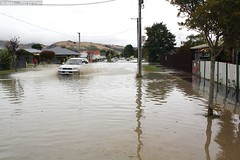
A video of an interview with Alison Naylor about her flooded house on Francis Avenue. Naylor talks about the lack of communication from the Christchurch City Council. She says that the flooding is worse than the liquefaction from the 2010 and 2011 Canterbury earthquakes.
The Space Between Words - Exhibition Panel 12: Wendy Griffiths
Articles, UC QuakeStudies
A pdf copy of panel 12 of Guy Frederick's 'The Space Between Words' exhibition. The panel includes text from an interview with Wendy Griffiths about her experiences of the 2010 and 2011 Canterbury earthquakes. Above this is an image of Griffiths on a beach.
Evans, Malcolm Paul, 1945-:[Time capsules discovered after Christchurch ea…
Images, Alexander Turnbull Library
Text above the image reads 'Time capsule discovered under founder's statue-' The statue of John Robert Godley, the founder of Christchurch, has toppled and a time capsule has been uncovered in the rubble by three rescue workers. One of them reads the document he has pulled out of the capsule and it says 'Personally I favoured Akaroa...' Context - the Christchurch earthquake of 22 February 2011 after which 2 time capsules were found under the John Robert Godfrey statue - they have been sent to Museum experts to open. Akaroa was largely unaffected by the earthquake. A Nelson newspaper 'The Colonist' in an article published in 1918 about the time capsule in Christchurch said, "This statute of John Robert Godley executed by Thomas Woolner was erected in the west side of the Cathedral Square by the Provincial Government of Canterbury, and unveiled by the late Sir Charles Christopher Bowen on August 6 1867, it was moved to this site in March 1918." (3 News 2 March 2011) Colour and black and white versions available Quantity: 2 digital cartoon(s).
Winter, Mark, 1958-: [Downsizemic activity - interest rates fall] 11 March…
Images, Alexander Turnbull Library
Text top left reads 'Downsizemic activity' and a seismic graph zigzags wildly but gradually tails off into the words 'Interest rates' which take a serious downwards trend. Context - The Christchurch earthquakes of 4 September 2010 and 22 February 2011 which have had an impact on an already stagnating economy. The Reserve Bank has made a relatively large 50-point cut in its benchmark interest rate, the Official Cash Rate (from 3% to 2.5 per cent). Critics say that inflation is already running unacceptably high and there is a threat of much higher inflation in a year or two when the rebuilding of Christchurch begins to put pressure on limited resources. The Reserve Bank acknowledged these factors, but it has chosen instead to focus on the immediate impact of the earthquake on the economy and particularly on all-important business and consumer sentiment. (Press editorial 12 March 2011) Quantity: 1 digital cartoon(s).
Auckland school raising funds for pupils in Christchurch
Audio, Radio New Zealand
The plight of Earthquake victims in Christchurch has struck a chord with the pupils at an Auckland school. More than 300 pupils at Pasadena Intermediate, in the suburb of Point Chevalier, have donned the Canterbury colours, raising money to help a school down South recover from the disaster.
Top Stories for Monday 20 September 2010
Audio, Radio New Zealand
More snow expected in Southland as region starts to mop up, United Future leader questions stability of Act, Seismologists say aftershocks tailing off for Canterbury, Questions raised over earthquake victims insurance, Gunmen attack tourists in Delhi shooting and Farm land drops two-thirds in value in one year.
Southern Story for 15 December 2011 - Linwood Village
Audio, Radio New Zealand
In response to the Canterbury earthquakes, the Government has built two villages in the suburbs of Linwood and Kaiapoi to provide temporary accomodation for those who've lost their homes. Our Christchurch correspondent, Katy Gosset, visited the Linwood Village and spoke to residents as they prepared for Christmas.
Question of secrecy looms over mosque attack inquiry
Audio, Radio New Zealand
The question of secrecy looms large over the newly announced Royal Commission into the country's security agencies. Nigel Hampton QC is a lawyer with extensive experience of top-level inquiries, including the Royal Commissions in the Pike River disaster and the Canterbury earthquakes. He talks to Guyon Espiner.
26 December 2010, 10:30 am
Videos, UC QuakeStudies
A video capturing an aftershock from the Canterbury earthquake on 26 December, 10:30 am. After a sharp aftershock in the morning, Ben Post set up the camera on a tripod and kept it running during the morning. The windows shown are approximately three metres square and double glazed.
Social cohesion: an investigation into post-earthquake Christchurch
Research Papers, Lincoln University
While there are varying definitions of the term ‘social cohesion’, a number of common themes regularly surface to describe what cohesive societies look like. Previous studies using known indicators of social cohesion have often been conducted at the international level for cross-country comparison, while there has been less focus on social cohesion within countries. The purpose of this research is to identify if indicators of social cohesion can be used to map trends at the city level in order to draw meaningful conclusions, particularly in the aftermath of a natural disaster. Using known indicators of social cohesion and Christchurch City as the basis for this study, variations in social cohesion have been found within the city wards, that preceded but were affected by the events of the Canterbury earthquakes during 2010/11. These findings have significant policy implications for the future of Christchurch, as city leaders work towards the recovery of and subsequent rebuilding of communities.
Smith, Ashley W, 1948- :[Bob Parker and Jim Anderton]. 20 September 2010
Images, Alexander Turnbull Library
Depicts Christchurch Mayor Bob Parker striking a pose under a spotlight while standing astride broken masonry. He is being interviewed by media. On the right of frame, Progressive Party leader and MP Jim Anderton is under dark clouds and caught under the Beehive. Refers to the 2010 Christchurch mayoral elections in which Parker won over Anderton. Prior to the 2010 Canterbury earthquake, Anderton was ahead in the polls. The quake devastation was said to have given Parker a bigger profile than Anderton and been a factor in his win (TV3 9 October 2010). Quantity: 1 digital cartoon(s).
Top Stories for Friday 17 February 2012
Audio, Radio New Zealand
A new report says the financial cost of a major earthquake in Wellington would be much bigger than the Canterbury quakes. Opposition parties attack the asset sales plan after Bill English's "it's just a guess" comment and cuts to jobs, services, and profits, hard times at Qantas.
Seismics in the City 2016 - Panel (Part 1)
Videos, UC QuakeStudies
A video of a presentation by Hon. Nicky Wagner, Associate Minister for Canterbury Earthquake Recovery, during a panel at the 2016 Seismics in the City Conference. The panel has three themes:A City on the Move: Collaboration and Regeneration: "'Christchurch is now moving rapidly from the recovery phase into a regeneration stage with Central and Local Government working with the wider community, including the business community to ensure we get optimal outcomes for greater Christchurch' (CECC)."Looking Back: Remembering and Learning: "What are the milestones? What are the millstones? What have we learnt? What have we applied?"Looking Forward: Visioning and Building: "What do we aspire to? What are the roadblocks? What is the way forward?"
Women's Voices Research Committee
Articles, UC QuakeStudies
A document with a photograph and details of the Research Committee of the National Council of Women of New Zealand (NCWNZ) project, Women's Voices: Recording women's stories of the Canterbury earthquakes. The Research Committee consisted of Liz Gordon, Rosemary Du Plessis, Judith Sutherland, Helen Gibson, Maureen Fordham, and Cheryl Anderson.
Nisbet, Alistair, 1958- :"How are we EVER going to rebuild with this stuff…
Images, Alexander Turnbull Library
Text reads 'The new liquefaction?...' and the cartoon depicts a huge mass of 'insurance red tape' inside which is a man with a spade. Two people stare despairingly at the red tape and the man says 'How are we EVER gonna rebuild with this stuff bubbling up!' Context: The people are trying to rebuild their house after the Christchurch earthquakes and are having trouble with their insurance company. The Press has been contacted by people unable to get insurance to buy new homes, construct buildings or start businesses. Business leaders have called insurance delays a "cancer" eating away at the city's recovery, and Earthquake Recovery Minister Gerry Brownlee has acknowledged insurance is an "ongoing problem". (The Press - 24 August 2011) Quantity: 1 digital cartoon(s).
Nisbet, Alistair, 1958- :Auckland... Christchurch... 10 September 2011
Images, Alexander Turnbull Library
The upper of two frames shows Auckland all lit up for the Rugby World Cup and the lower frame shows Christchurch with a backdrop of munted buildings and a few people creating light with candles and torches. Context: The cartoon shows a contrast between the two cities as Christchurch struggles with the aftermath of the earthquakes and Auckland revels in the Rugby World Cup festivities. Quantity: 1 digital cartoon(s).
Evaluating the Efficacy of Paleoliquefaction Analysis Techniques Using Mod…
Research papers, University of Canterbury Library
Using case studies from the 2010-2011 Canterbury, New Zealand earthquake sequence, this study assesses the accuracies of paleoliquefaction back-analysis methods and explores the challenges, techniques, and uncertainties associated with their application. While liquefaction-based back-analyses have been widely used to estimate the magnitudes of paleoearthquakes, their uncertain efficacies continue to significantly affect the computed seismic hazard in regions where they are relied upon. Accordingly, their performance is evaluated herein using liquefaction data from modern earthquakes with known magnitudes. It is shown that when the earthquake source location and mechanism are known, back-analysis methods are capable of accurately deriving seismic parameters from liquefaction evidence. However, because the source location and mechanism are often unknown in paleoseismic studies, and because accurate interpretation is shown to be more difficult in such cases, new analysis techniques are proposed herein. An objective parameter is proposed to geospatially assess the likelihood of any provisional source location, enabling an analyst to more accurately estimate the magnitude of a liquefaction-inducing paleoearthquake. This study demonstrates the application of back-analysis methods, provides insight into their potential accuracies, and provides a framework for performing paleoliquefaction analyses worldwide.
Research Engagement after Disasters: Research Coordination Before, During,…
Research papers, University of Canterbury Library
This article argues that active coordination of research engagement after disasters has the potential to maximize research opportunities, improve research quality, increase end-user engagement, and manage escalating research activity to mitigate ethical risks posed to impacted populations. The focus is on the coordination of research activity after the 22nd February 2011 Mw6.2 Christchurch earthquake by the then newly-formed national research consortium, the Natural Hazards Research Platform, which included a social science research moratorium during the declared state of national emergency. Decisions defining this organisation’s functional and structural parameters are analyzed to identify lessons concerning the need for systematic approaches to the management of post disaster research, in collaboration with the response effort. Other lessons include the importance of involving an existing, broadly-based research consortium, ensuring that this consortium's coordination role is fully integrated into emergency management structures, and ensuring that all aspects of decision-making processes are transparent and easily accessed.